Tea-ing up
Updated: 2009-09-30 10:23
By Ye Jun(China Daily)
|
|||||||||


|
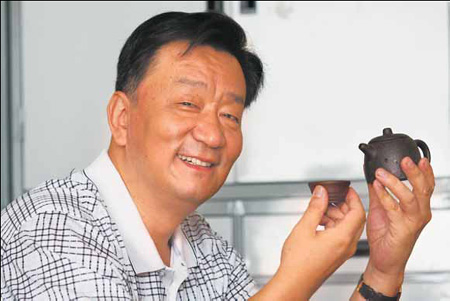 Tea connoisseur Wang Qing says the classic Chinese beverage is in need of a revamp to suit global tastes. [China Daily] |
For Beijinger Wang Qing, tea is a way of life.
"In the morning, I drink a cup of refreshing green tea. In the afternoon, I drink an aromatic cup of tieguanyin," says Wang, 45.
"In the evening, I drink black, dark or oolong tea, to aid digestion without disrupting my sleep."
Wang is a tea drinker in a country considered to hold the earliest records of the habit.
The history of picking and consuming tea in China dates back more than 2,000 years, with ancient Chinese scholars immortalizing the beverage with famous poems.
Wang's first impressions of tea date back to his childhood.
"As a boy, I would go to teashops to buy 'gaomo' or powdery remains of jasmine tea."
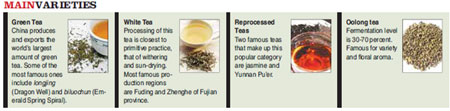
But it was not until Wang worked at the Ministry of Commerce that he got to know other Chinese tea varieties such as white tea, yellow tea, oolong tea, black tea, dark black tea and reprocessed teas like Pu'er. Over the years, Wang's work has taken him to 1,000 Chinese counties.
In 2004, Wang was transferred to the China Tea Marketing Association and became executive vice-chairman of the semi-official organization.
"I tried all kinds of tea ... these included almost every traditionally famous tea of China."
Those in the country's southern regions are known for drinking mostly green tea, while their northern counterparts are said to enjoy jasmine tea.
Still, China's tea production has seen great changes over the years.
"When the People's Republic of China was founded in 1949, the country's tea production was only about 10,000 tons," Wang says.
"In the1970s, it was just more than 100,000 tons."
But last year alone, China produced 1.24 million tons of tea, taking up one-third of the world's total tea production with an output value of 30 billion yuan.
"China has 21 provinces and 900 counties that produce tea."
"There are 240 million tea drinkers, 80 million tea farmers and 50 million tea traders in the industry."
China's vast tea producing regions also extend to Tibet in the west, Shandong in the north and Hainan in the south.
The country has 1.6 million hectares planted for tea, with production surpassing India to become the world's largest since 2005.
China is also the third-largest tea exporter in the world, ranking after Kenya and Sri Lanka. Last year, China exported 297,000 tons of tea, 80 percent of which was green tea.
Compared with 60 years ago, Chinese tea producers have also equipped themselves with advanced tea-making technology.
"Tea is being used for many other purposes, with scientific analyses backing up its health benefits," Wang says. These include polyphenol extract pills and tea fiber for clothing.
Still, Wang says Chinese tea consumption has not grown as swiftly as tea production.
"In the past seven or eight years, average consumption grew at a lukewarm 10.7 percent," he says. Wang estimates China's full annual tea production capacity to be 1.5 to 1.6 million tons.
But Wang says tea continues to be more than just a beverage in the Chinese psyche.
"It is a way to balance myself mentally and a great way to socialize.
"But it's understandable that fashion-conscious youth these days would rather drink coffee and cola."
Wang concedes that Chinese tea needs a revamp.
"It is time for tradition to merge with reality," he says.
"That's one way for Chinese tea to take global strides."
Time line
1949
Tea becomes a key resource for export through the newly set up China Tea Company, the first State-run firm that manages the tea trade. China exports 9,900 tons of tea during the year.
1950
China General Tea Company, the first Chinese State-run company, is set up to manage tea trade in the country.
1956
Zhejiang tries out and promotes mechanized tea making, a step soon followed by other provinces.
1950-1970s
The area taken up by tea gardens in the country rises 7.3 percent a year following a series of promotional campaigns. Tea production increases 5.9 percent annually.
1984
China opens up tea for free trade.
1988
Lao She Teahouse set up as the first teahouse in Beijing and China amid the country's reform and opening up.
1994
Wufu (Five Fortune) Tea Ceremony Teahouse founded as Beijing's first teahouse specializing in the tea ceremony.
2005
China's overall tea production exceeds India's to become world's No 1.
2008
Chinese character "tea" appears at Beijing Olympics opening ceremony as a symbol of traditional Chinese culture.