LIFE> Yunnan Attractions

|
LIFE> Yunnan Attractions
|
|
Dali
(www.yunnantravel.net)
Updated: 2009-11-17 16:04
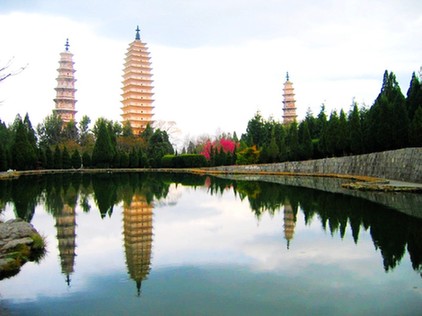 For many centuries, Dali was the principal city of Yunnan, far more important than Kunming. Dali was the capital of the Nanchao Kingdom which made its power felt deep into China. Much later, in the mid-19th century, Dali was a Muslim stronghold from were the Yunnan capital of Kunming had been raided several times. Still now, Dali is predominantly inhabited by Bai people, one of the strongest ethnic minorities in Yunnan province. The Bais are closely related to the Thais of Thailand, as well as to another ethnic minority in Yunnan province, the Dais. Actually, the Thais of Thailand only became an ethnic group distinct from the Bais and Dais of Yunnan after Kublai Khan had defeated the Nanchao Kingdom. At that time, a large number of the Nanchao aristocracy, together with many of their subjects, migrated south, into Southeast Asia and present-day Thailand where they dislodged the Khmers who at that time were ruling over much of Southeast Asia. The Thai group of people now classified as Thais, Dais, Bais, and under various other names, had been settling the Dali area for more than 3,000 years. Even today, there is much awareness among Thais that Yunnan is where they originate from. Like Kunming, Dali, some 400 kilometers to the west, is located near a major lake, Erhai Lake. And like Kunming, Dali lies at an altitude of about 1,900 meters. The main attraction of Dali is probably the surrounding countryside. To the west lies the Cangshan Mountain Range with peaks well above 4,000 meters and a large number of most picturesque Buddhist temples. Unlike the Han Chinese, the Dais and Bais of the Dali area are Hinayana Buddhists, so one may see saffron-robbed monks. Attractions in Dali: Dali Museum The small Dali Museum has archeological finds relating to the history of the Dai and Bai people. Three Pagodas The Three Pagodas, though not as famous as those on the Three Pagodas Pass between Thailand and Myanmar, are among the oldest still-existing architectural structures in all of Southwestern China. The tallest of the three was built in the 9th century and reaches a height of some 70 meters. The two smaller pagodas are about 42 meters high. A temple behind the pagodas is a fine example of traditional Yunnanese architecture. |
衡山县| 高邑县| 邯郸县| 五大连池市| 洛扎县| 清涧县| 丰都县| 东安县| 原阳县| 福鼎市| 凤城市| 北川| 隆德县| 东源县| 青田县| 读书| 民丰县| 小金县| 龙岩市| 乌鲁木齐县| 彭水| 恩平市| 汪清县| 曲靖市| 林州市| 嘉义市| 台前县| 高雄县| 罗田县| 车险| 来宾市| 芮城县| 湖南省| 壶关县| 遂溪县| 时尚| 湘潭市| 孟村| 邳州市| 麻城市| 毕节市|
