Tailored training fills talent gap
 |
|
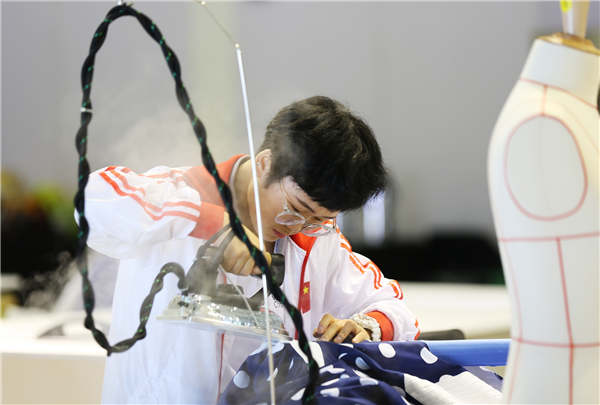
Hu Ping competes in the fashion technology section in the 44th WorldSkills Competition. [Photo provided to China Daily] |
"Efficiency in garment layout and keeping a neat work top - these details test professionalism and craftsmanship," Hu says.
Wang Jianbai, director of the Light Industry Branch of the Beijing Industry and Trade Technician College, is interested in the integration of industry and education. Over the years, the school has formed alliances with well-known garment companies such as Rose Studio Haute Couture, Hongdu Clothing and Aimer, to jointly train students.
"We make teaching plans with these enterprises. During the course, they send designers and technicians to offer instruction and evaluation. Some enterprises set up scholarships in our schools; some set up programs to enable students to go directly to the company after they graduate," Wang says.
China's garment industry is disadvantaged by lack of creative designers and a shortage of technicians who can turn ideas into products.
"We are not training traditional sewing workers, but cultivating all-around talented professionals who know both design and production," Wang says.
"I believe more students like Hu Ping entering the job market will help promote the transformation and competitiveness of China's garment industry."
According to research into China's labor market jointly released by Tsinghua and Fudan universities, China is gradually transforming its industry base from low-end manufacturing to the production of quality value-added products, which calls for more highly skilled industrial workers.
Joint guidance on the development of China's manufacturing skills from the Ministry of Education, Ministry of Human Resources and Social Security, and Ministry of Industry and Information Technology says China is expected to face a shortage of 3 million skilled workers to operate robots and high-end numerical control machines by 2020.
Xing Hui, director of the Vocational Education Center of the National Academy of Education Administration, believes the transformation and upgrading of manufacturing poses new challenges for China's vocational education.