Well of ideas for China's water
 |
|
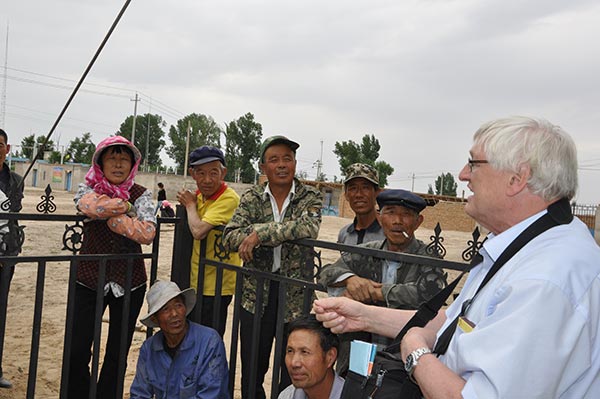
Wolfgang Kinzelbach talks to local farmers on one of his trips to China. [Photo provided to China Daily] |
Since the late 1970s, Wolfgang Kinzelbach has often visited China. The 66-year-old former professor of hydromechanics at Swiss Federal Institute of Technology is a citizen of both Germany and Switzerland. In 1979, he became the first long-term scholar in a scientific exchange program between Germany's Max Planck Society and the Chinese Academy of Sciences.
Although he witnessed China's overall development in the past decades, he paid closer attention to environmental issues as a scientist. And according to him, there has been an imbalance between protecting the environment and the country's rapid development.
Having lived in Taiwan for a period earlier, the Chinese mainland seemed a big contrast to him, he says.
"Consumption was low (on the mainland) and people were a big army of 'blue ants'," Kinzelbach tells China Daily via e-mail.
He taught courses on modeling of the aquatic environment at the Institute of Environmental Chemistry of CAS in the early 1980s.
In 1986, he was invited to China again to teach a new version of the course at Tsinghua University. The contents of his teaching were later published as a book in Chinese.
"I continue to come across people in China who have learned modeling of water systems from that book. You can imagine that I enjoy these encounters," he says.
Among Kinzelbach's close friends in China is Li Wenpeng-h(huán)is research partner. They have worked together on the Yanqi Basin of the Xinjiang Uygur autonomous region, and many other groundwater projects.
To Kinzelbach, who previously lived in West Africa for a couple of years, neither the arid environment of Xinjiang nor the halal food there were unfamiliar.
"I never felt like a foreigner in Xinjiang, with people being so hospitable," says Kinzelbach.
Of the universal problem of groundwater, he says: "Agriculture and nature are the two big competing users of fresh water. Both are needed for our survival. How to find a compromise between them? There's no free lunch."
But their research on Yanqi Basin showed that "lunch could come at a bearable cost", with measures including modern irrigation methods.
After carrying out a successful project that involved real-time measurement control of groundwater pumping and infiltration wells in Zurich, Kinzelbach suggested the same technique be used for a new project meant to control the overuse of aquifers in China last year.