Laying Garbage to waste
 |
|
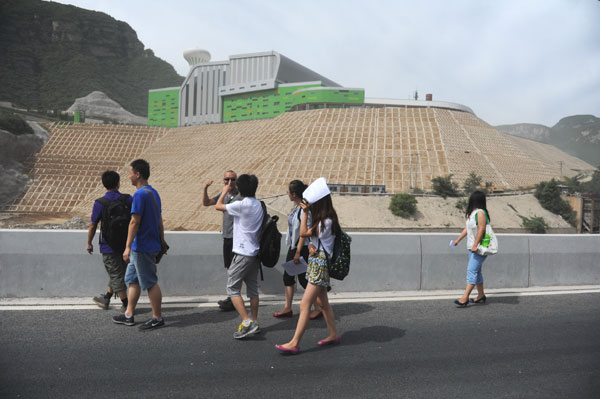
Visitors walk past Lujiashan, the largest waste incenator in the world, on July 29. [Photo by Wang Wei/For China Daily] |
The world's largest incinerator will ensure that Beijing's household garbage is not only disposed of in an eco-friendly manner, but also produces electricity for the energy-hungry city, writes Li Yang.
The world's largest waste incinerator will start running at full speed next month after one year's trial run. The incinerator in Beijing's western suburb can process 3,000 tons of household garbage a day, that is, one-sixth of the daily domestic waste generated in the city.
The Lujiashan incinerator has been built by Shougang Group, one of China's largest steel producers, in a deserted limestone quarry. Before Lujiashan started its trial run, more than 80 percent of Beijing's household garbage was consigned to more than 30 landfills spread around the city, with about 10 percent being processed to make fertilizers.
The Lujiashan incinerator will receive sorted household garbage from Dongcheng, Xicheng, Fengtai, Shijingshan and Mentougou districts of Beijing, which will first be dumped into a 30-meter-deep treatment "pond" where it will be left to ferment for a week. The pond, making good use of the limestone quarry, can hold up to 40,000 tons of waste at a time.
The custom-built air-blast system will keep the atmospheric pressure in the pond lower than that outside and thus keep the smell of rotting garbage locked within the pond and spare the neighborhood of the stink. Also, the "fermentation" will increase the waste's heat generation capacity by a large margin.
After the garbage "ferments", mechanized buckets will dump it into four incinerators, which are actually waste heat boilers. The incineration will reduce the volume of the garbage by about 90 percent within a short time and the heat generated by the incineration can be transformed into electricity through two 30-megawatt air-cooling turbo-powered generators.
Liu Yangsheng, a professor of environmental sciences at Peking University, says that if the waste's heat value is more than 4,300 kilo Joules per kilogram, the waste can be incinerated to generate electricity.
Since the average heat generating capacity of Beijing's household garbage is about 6,800 kilo Joules per kg, it can become a good source of energy for the power-thirsty city. In fact, Lujiashan can generate 420 million kilowatt hour of power in a year, which is equal to that generated by 140,000 tons of standard coal. Moreover, the more than 800 C temperature can eliminate dioxin, a carcinogenic pollutant and a byproduct of outmoded waste incineration technology, from the emissions.