Genome screened baby is born disease-free
 |
|
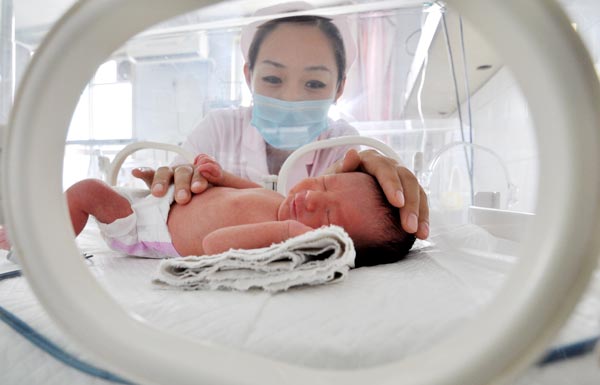
A nurse tends to a newborn baby in Hebei province on August 31, 2014. [Photo by Hao Qunying/Asianewsphoto] |
 |
| China's potent answer to Viagra |
 |
| Angelina Jolie surgery sparks surge in female cancer tests: study |
The birth is good news for patients with monogenic diseases, as they can expect to have offspring that won't be born with their disorders.
In this case, the father suffers from a hereditary disorder characterized by multiple bony spurs or lumps on the bones, which has a 50 percent chance of being transmitting from parent to children.
Qiao Jie, president of the hospital, together with her research group, was able to select a normal embryo free of the father's disease allele, using a technique developed by Sunney Xie's lab. Xie, a Mallinckrodt Professor of Chemistry and Chemical Biology at Harvard University, is a visiting professor at Peking University.
A total of 18 embryos at the blastocyst stage were obtained from the couple, and a few cells were biopsied from each of the five-day to six-day embryos. Then the researchers amplified genomic DNA from the cells to conduct a whole genome sequencing analysis. The team identified three healthy embryos and finally chose the healthiest one to transfer back to the wife.
Later analysis of amniotic fluid showed the baby was free of aneuploidy and mutated allele.
The baby had a birthweight of 4.03 kilograms and was 53 cm in length. Umbilical cord blood genome detection confirmed the baby was free of the mutated allele.
There are about 7,000 known monogenic diseases, and the mutated genes of about 4,000 monogenic diseases are already known. Most monogenic diseases can cause death, disability or congenital malformation, and only a few can be treated effectively.
The genome project was done with the support from the Ministry of Science and Technology, Beijing Municipal Science and Technology Commission, the National Natural Science Foundation of China and the 985 project of Peking University.
It was accomplished through the cooperation of the three partners: Jie Qiao's team at Peking University Third Hospital, Sunney Xie's laboratory and Fuchou Tang's laboratory at the Biological Dynamic Optical Imaging Center (BIOPIC) of Peking University.