Timeless tunes
|
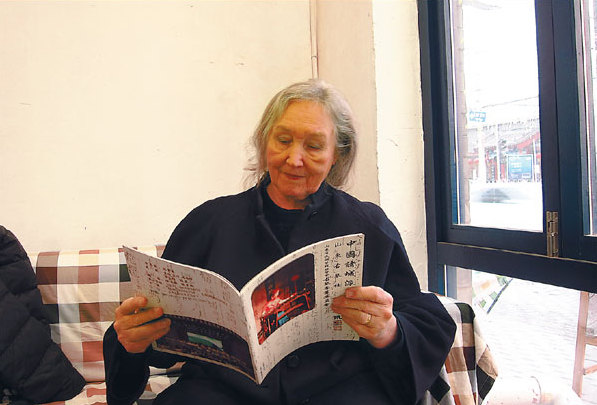
Swedish Sinologist Cecilia Lindqvist reads a Chinese book about guqin in Beijing. Sun Ye / China Daily |
My China Dream |
C ecilia Lindqvist
 |
| 'Clothesline' shock leads to meteorology career |
 |
| A visionary rooted in service |
When the two friends of some 50 years saw each other for the last time, at the older woman's deathbed, they spoke about a seven-string plucked instrument, guqin.
"Her final question was, 'Is there anything you'd want to know about the instrument?'" recalls 82-year-old Swedish Sinologist Cecilia Lindqvist of that 2005 meeting on a wintry afternoon, tears welling in her eyes. Her friend and instructor, Wang Di, passed away four days later.
It's only appropriate that the final subject the two friends spoke about would be guqin, the 4,000 year-old instrument that brought them together and has been the focus of Lindqvist's lifelong study.
Lindqvist, former chair of the Sweden-China Association and professor of Stockholm University and Beijing Language and Culture University, finished writing her book, Qin, several months later.
The book was released in 2006 and promptly won one of Sweden's biggest literary prizes, the August Award. The book details guqin music as well as "civilization's fate, feelings and dreams" and recently was added to the required reading list for Chinese middle-school students. Its revised second-edition is due out this spring.
Lindqvist, student of famed Swedish Sinologist Klas Bernhard Johannes Karlgren, who is well-versed in piano, lute and several languages, came to China at the age of 28 in search of a different kind of music. "Western music, like Beethoven, is too masculine," she says.
It was 1961, and her Peking University language classes were still taught with "Proletariat around the world, unite!" as example sentences. Times were so bad that she had to sustain herself on intravenous drips of protein while the rest of the university students peeled twigs off trees for food.
But she would be grateful for the following two years and remember them as "wonderful times", as she spent them at the Guqin Research Center, a courtyard that housed the country's most celebrated guqin players. Wang Di, who was then in her late 30s, became her instructor.
For more My China Dream stories, click here