The peony's blossoming business
|
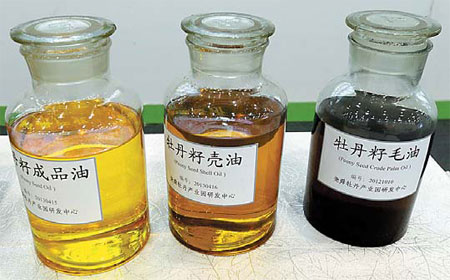
The oil distilled from peony seeds could be a revolution in high-end cooking oil across the world. Photo / Ju Chuanjiang |
|
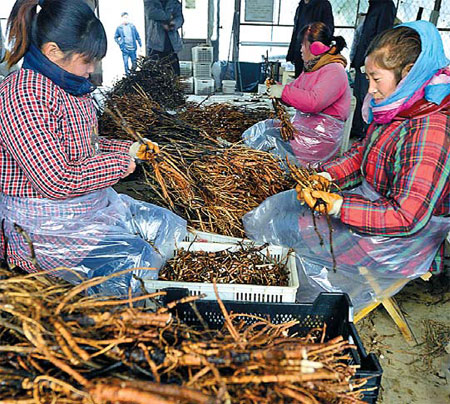
Workers sort peony roots to be used in herbal medicine. |
Supported by technologies from Beijing Forestry University, the Chinese Academy of Forestry and the State Forestry Administration, technicians in Heze began to study peony seed oil in 2003. Completed in a lab at the Chinese Academy of Forestry in 2006, the results showed peony seed oil is composed of 43.18 percent alpha-linolenic acid, a content 61 times higher than olive oil and six times more than soybean oil.
In 2011, peony seed oil was recognized as a new food resource in a statement from the Ministry of Health.
"The peony seed oil industry will help maintain grain and oil safety," says Li Yucai, head of the China Forestry Economy Society. China bought 5.98 million tons of vegetable oil in overseas markets in the first three quarters of 2013, a year-on-year increase of 9 percent, according to the General Administration of Customs.
Each Chinese resident consumed an average of 18.5 kg of oil in 2012, an increase of 7.5 kg over 2001. The China National Grain and Oils Information Center forecasts the figure will reach 23 kg between 2017 and 2022 as living standards continue to rise.
In addition to containing richer nutrients than the soybeans widely used in China for cooking oil, peony seeds produce more oil.
"The oil from one mu (0.07 hectare) of peony cultivation is 3.4 times more than that from soybeans," says Zhang. "And the peony is generally hearty and requires little care. In China, 24 provinces are suitable for planting peonies."
To capitalize on the bright prospects, local governments in China began planting more peonies in 2011.
By the end of last year, a combined 20,000 hectares in Shandong, Henan, Hubei, Gansu, Chongqing and Anhui were growing peonies for cooking oil. They are expected to produce 57.85 million kg of seeds in 2017 when they begin to produce seeds, according to statistics from Mudan district.
Gansu has released a plan to develop 69,330 hectares for oil-oriented peony cultivation by 2020. Shandong plans to develop 533,300 hectares by 2020.
As a pilot area for developing peony seed oil supported by the Chinese Academy of Forestry, Heze planted 18,000 hectares this year, 62 percent of the city's total. The figure is expected to reach 133,330 hectares in 2020.
Nine companies in the country now have a total annual production capacity of 15.87 million kg.
But due to the shortage of seeds and low demand, their production this year fell far short of that.
Heze Yao has the world's largest production line, able to produce up to 10 million kg, yet the company only produced 200,000 kg this year.
And due to low output, the price for the peony oil is high.
A 275 ml bottle of peony seed oil produced by Li's company sells at 1,000 yuan ($165). Their products are now on sale in metropolises such as Beijing and Shanghai.
"Our production this year is short of demand," says Chen Limin, deputy general manager at Heze Yao. "Some people already know the value. It can be used in not only for cooking and healthcare, but also in cosmetics."
Experts say the price will be reduced to 300 to 400 yuan per kg by 2020.
"The peony usually takes four to five years to produce seeds. So oil output will be greatly raised when those planted begin to produce," says Chen Xuexiang, director of the management office of the national peony hi-tech industry base in Heze. Heze also grows 90 percent of the peonies used in landscaping, says Zhang.
Horticulturists in the city cultivate 1,237 varieties of peony that are used in more than 100 cities in China and some 20 countries including France, Canada, Netherlands and Belgium.
Peony paintings of the flower known as the fuguihua, or the blossom of riches and honor, sell well.
Hundreds of artists in Heze are involved in painting peonies. "We hope the peony industry blooms across our country. We are glad to see more people benefit from the quality products," says Zhang.