Searching for a song
 |
|
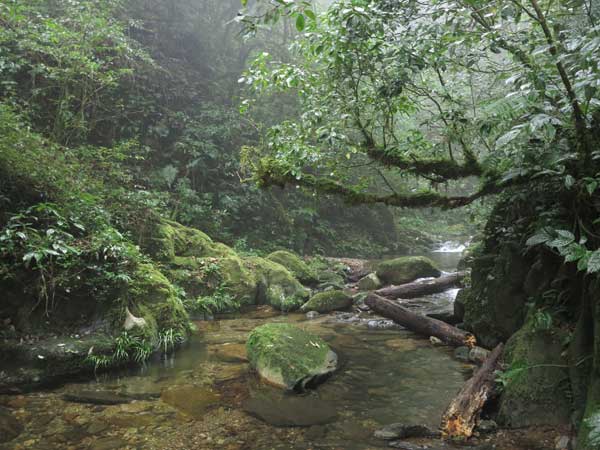
River trekking is part of the four-day journey. |
In the wet
The stars gave me hope for a sunny day. But the thick mist clouding the camp lowered our expectations of being able to enjoy the gibbons' singing early the next morning.
"Living in the forest, the gibbon couples often use duets to strengthen their bonds, or advertise their presence within the territory," Yang says. "But they don't like singing in the mist, and even less so in the rain."
|
|
| Last of the gibbons |
|
|


We failed to hear the gibbons' singing that morning. We needed to walk an elevation of only 100 meters to our second camp that day. But the route involved many ups and downs. It was a difficult and sometimes tedious journey.
It took me more than six hours to complete the walk. When I arrived at the camp, I found it was on a declining slope and my tentmate and I needed to find a flat stretch of ground in the woods and bamboo groves to make camp. But most patches of "tent-sized land" were occupied by trekkers who had arrived before us. So we had to create a "flat base" using a spade and knife so we could set up camp.
The camp was right on a ridge overlooking forests with three families of gibbons in three directions. We were told it is a place where "you might be able to listen to the gibbons' singing from your tents".
But we didn't. Getting out of the tent, I found the dew on branches falling like rain and dampening our tents and packs. It was misty and cold.
The mist had finally became a drizzle. The two-hour descent became treacherous. I tumbled a few times on the way down to a valley that had a river running through it.
The river was surrounded by large trees, towering at more than 30 meters. Many of the trees are the endangered Tetracentron sinense Oliv, said Fang Wei, a botanist from the Kunming Institute of Botany. This tree, mainly found in South and Central China, is a relic species growing only in well-protected primitive forests.
But its star-shaped leaves were everywhere along the trail. "A big community of the trees means the forest is healthy," Fang said. "These trees are one of the reasons why the gibbons are still here."
Related:
Although few participants of the recent trek on the Ailao Mountains (Ailaoshan) managed to hear the western black-crested gibbons' duets, no one seemed to regret taking part. More...
For more Eco China, here