Under the microscope
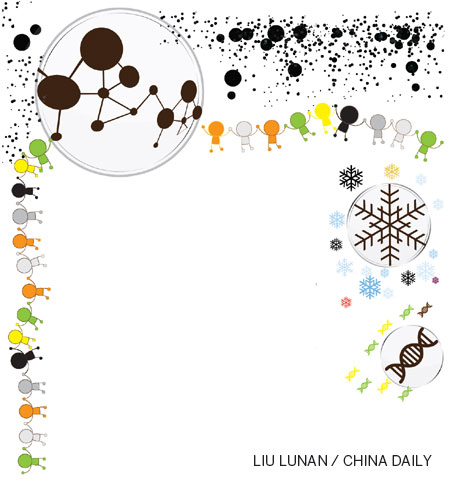
Advances in technology have allowed scientists to observe a hydrogen bond, a great leap forward in the study of life science. Cheng Yingqi reports.
Ever since Galileo Galilei invented the microscope 500 years ago, leaps in technology have extended our vision further into the world beyond the naked eye-from insects' eyes to cells, molecules and atoms. Now scientists are observing the hydrogen bond, a weak bond among individual molecules. "To observe molecules and the bond that links them together is like using a super telescope to observe a human from the moon. In the past we found a crowd of people standing on the Earth; now we can see that these people are holding hands with each other," says Qiu Xiaohui, an author of the research paper, Real-Space Identification of Intermolecular Bonding with Atomic Force Microscopy, which was recently published in Science magazine.
"The observation system opens up broad prospects for understanding the mechanism of intermolecular interactions."
"Chemical bonding, paralleled to periodic law of elements, is the greatest discovery in chemistry, which allows us to understand the chemical nature of matter," says Liu Minghua, director of the National Center for Nanoscience and Technology, China.
When two or more atoms join together to form a molecule, they are linked together by chemical bonding. The strongest type of chemical bond is a covalent bond.
"For an analogy, the covalent bonds are like your arms-they are stitched to a molecule. If we rip them off, the molecule falls apart, "Liu explains.
"The hydrogen bond, on the contrary, is like people holding each other's hands. The way they stand there holding their hands determines the shape of their formation-or the internal structure of a matter-but if we cut off the hydrogen bond, there will not be molecular changes, or what we call a chemical reaction," he says.
The first ever high-resolution images of covalent bonds were reported in 2009 by Leo Gross and his colleagues at IBM-Zu-rich Research Laboratory, yet the images of hydrogen bonds had never been captured before Qiu's team did so.