|
 |
|
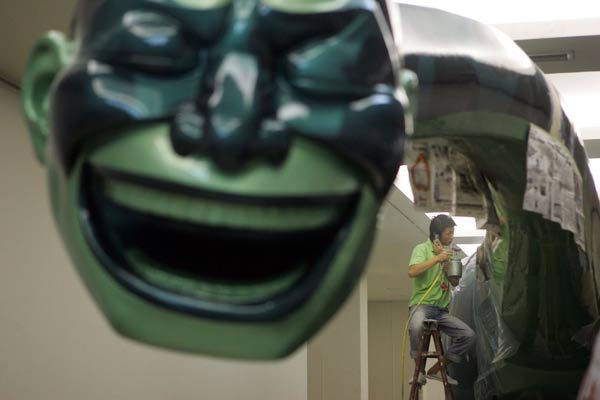
Works by Yue Minjun on display at 2008 Shanghai Biennial. Gao Erqiang / China Daily |
"Many biennials are named after the cities where they are held. So a good biennial's theme must be closely connected to the city's history and culture, and tell the stories of people living there," Zhang says.
Ivy Lin, a curator from Hong Kong Art Promotion Office, says she is impressed that the Shanghai Biennial has consistently focused on local social issues, such as urbanization and migrant population.
"What makes a biennial interesting is that artists share with the audience their various opinions about the social changes have happened in the past two or three years," Lin says.
Moreover, a biennial or triennial is able to go deeper academically by engaging artists in the pursuit for solutions to the social problems, according to art critic Duan Jun.
He gives a thumb's up to Guangzhou Triennial's Delta Laboratory, a project which invites artists at home and abroad to come to the Pearl River Delta to find inspiration for their art and exhibit it there.
Social groups that have aroused artists' interest include people living in villages inside big cities, children of migrant workers, beggars and sex workers.
Watching these people's lives and talking to them face-to-face fueled artists' passion about their creations so they came up with interesting forms of expression, such as experimental drama.
Zhang, the experienced curator who is now director of National Art Museum of China's research and curatorial department, says many curators in China lack the ability to conceive a thought-provoking exhibition theme.
September's Asian Art Curators' Forum hosted in Guangzhou offered participating Chinese curators a great opportunity to learn from their peers elsewhere in Asia and the West.
The National Art Museum of China also hosted a seven-day professional training course last year for 36 curators from art museums across the country. It included case studies and lectures by experts from home and abroad on curatorial theories in China.
"Art museums shouldn't be responsible for offering curatorial training. But none of the universities in China has established a major in curatorial practice. The training is only part of the course about art management and the instructors don't have much working experience as curators," Zhang says.
However, Zhang is confident that Asian art museums and exhibitions will catch up with the West.
Despite their short histories, some biennials/triennials hosted in Asia including Yokohama Triennial in Japan, Kwangju Biennial in South Korea, Singapore Biennale and the Asian Art Biennale held in Dhaka, Bangladesh, have attracted global attention with their distinctive styles and reflections of the hosting countries' cultures.
Zhang says he is most impressed by the biennale in Bangladesh, where the government and people are passionate about developing art though the country suffers an undeveloped economy and regular unrest.
"With people dedicated to art development like those in Dhaka, Asian biennials/triennials will quickly grow into shows as influential as those in the West," says Zhang. "The rich and profound cultures of Asian countries are the best soil for art to grow."
Contact the writer at xujingxi@chinadaily.com.cn.
|
|
|
|
|
|
|
|
|
|


Copyright 1995 - . All rights reserved. The content (including but not limited to text, photo, multimedia information, etc) published in this site belongs to China Daily Information Co (CDIC). Without written authorization from CDIC, such content shall not be republished or used in any form. Note: Browsers with 1024*768 or higher resolution are suggested for this site.
License for publishing multimedia online 0108263 Registration Number: 20100000002731 




















 Raymond Zhou:
 Eco China
 Ye Jun:
 Pauline D Loh: My Chinese Kitchen
 China Face
 Pauline D Loh: