Vision of for-profit tactics to help charities
 |
|
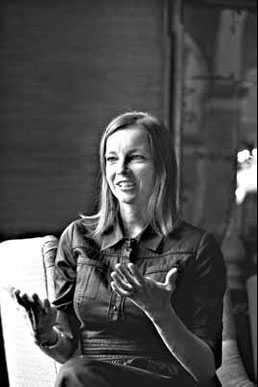
Lindsay Beck came up with an idea in business school of a profit-driven stock market for philanthropies. [Photo/Agencies] |
Lindsay Beck, a cancer survivor who had founded a successful charity, started thinking about how the world of finance and Wall Street could revolutionize the staid nonprofit industry when she became consumed with this question: "Could there be a Nasdaq for not-for-profits?"
The idea - creating the equivalent of a profit-driven stock market for nonprofits - might seem counterintuitive. It was a "radical idea, and maybe I was naive," she acknowledged.
But, in the last year, the concept has gained enough traction that it has won her meetings with executives at Goldman Sachs, Deutsche Bank and members of the Obama administration. A team of lawyers has been working to understand the tax implications and how to comply with Securities and Exchange Commission rules. Ms. Beck's idea has the potential to upend part of the global economy if it succeeds. By some estimates, if just 1 percent of the money in the portfolios of wealthy individuals in the United States was directed to nonprofits through new financial instruments like social-impact bonds or Ms. Beck's exchange, the nonprofit world would be sitting on $1 trillion.
Wall Street is littered with clever plans to use financial instruments to change behavior - carbon trading, for example. Some have changed the world, and others failed miserably.
Several ideas about using financial instruments and a for-profit approach in the world of nonprofits are taking hold. This month, Goldman Sachs announced a $250 million social-impact fund. Morgan Stanley plans to raise $10 billion over the next five years for what it calls its "investing with impact platform."
In September, JPMorgan Chase teamed up with the Bill and Melinda Gates Foundation to start a $94 million investment fund to finance late-stage drugs, vaccines and tools to fight diseases like malaria, tuberculosis and H.I.V./AIDS.
Ms. Beck's idea is an outgrowth of her experiences. She started a nonprofit, Fertile Hope, which helped female cancer survivors with pregnancy.
Later, she began examining how to make nonprofits more efficient at fund-raising. She says she has long believed that charitable money is often misallocated; some of the most effective organizations struggle to raise funds, while some of the least effective are allocated millions.
That got her thinking: An exchange, like a stock market, would make the success - or failure - of organizations more transparent, leading to more money in the best hands. Also, if donors thought about their charity as an investment it would transform the nonprofit sector.
"When you take off your charity hat and put on your investor hat, you behave very differently," she said.
She has been inspired, in part, by several programs that Goldman Sachs developed to sell so-called social-impact bonds.
The company created a $9.6 million loan for New York City for a program run by MDRC, a social services provider, aimed at preventing former city inmates from ending up back in jail. The program has clear goals and benchmarks. If recidivism drops by 10 percent, Goldman will be repaid the full $9.6 million by the city. If recidivism decreases more than that, Goldman could make a profit, capped at $2.1 million. However, Goldman would lose up to $2.4 million if recidivism does not fall at least 10 percent.
Goldman has used its money to finance such programs. But now, it and other firms are coming up with ways to turn these types of programs into investments for their clients. JPMorgan's $94 million fund works because the Gates Foundation is offering to protect investors from the potential downside of investing in risky new drugs and vaccines.
"At the outset of the investment, you are underwriting both sides of the ledger: the financial side and the social side," Alicia Glen, a managing director at Goldman Sachs, said of these new bond products.
Ms. Beck says that to expand such a program broadly, an exchange needs to be created to allow investors to trade these instruments. That way, they could hold the most successful ones and dump the duds.
From a technical perspective, the current spate of "impact bonds," she said, is mostly "just multiparty contracts with contingent payouts."
She is developing ways to create a common system to develop social-impact bonds that are, in her words, "real bonds."
Ms. Beck's vision for an exchange "is very creative and visionary," Ms. Glen said, "but it may take a long time to come."