Private sector lures more medicos
|
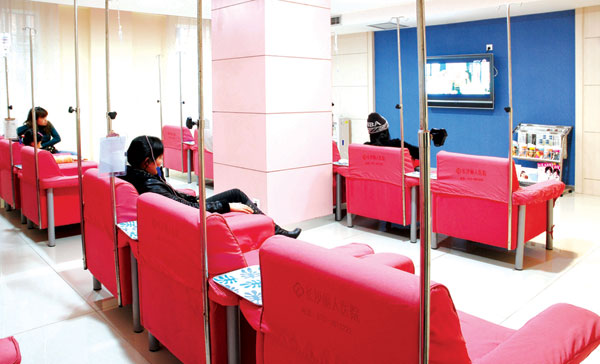
Patients at a private hospital in Changsha, Hunan province, rest while receiving treatment. CFP |
"I want to be a dignified doctor who treats patients with dignity," says Zhang Qiang, 47, former vascular surgery department director with Shanghai East Hospital, a famous public hospital in Shanghai. He now works at a private clinic.
"After years of effort, I've realized I cannot achieve that under the current public hospital system."
He used to see dozens, and sometimes more than a hundred, patients a day - spending just a few minutes with each - in the noisy public hospital environment, where patients' privacy and comfort was not considered an important issue.
He also had to allocate remarkable time and energy to administrative affairs, such as redundant meetings and paperwork, and could not devote himself fully to treating patients.
In fact, most doctors in public hospitals are under extreme pressure physically, emotionally and ethically, according to Liu Guoen, an economist and healthcare reform specialist with the National School of Development, Peking University.
China has only 2.4 million doctors, which is almost the same number as 10 years ago, for 1.4 billion people, and has largely lagged behind the social need, Liu says.
Besides, doctors are not well paid in the public system and cannot practice freely in other medical institutes to earn money legally, Liu adds.
Zhang, the vascular surgeon, says doctors in the public system are overloaded with work, get meager legal income, have few opportunities for promotion, but have to face patients who tend to vent their dissatisfaction and anger on medical staff.
On Oct 25, a patient stabbed one doctor to death and wounded two others in Wenling, Zhejiang province, because he was upset with a surgery on his nose. The patient was later diagnosed with mental health problems.
Most importantly, receiving limited funding from the government, public hospitals have to make money to provide for staff members and hospital development, which causes over-treatment and corruption, and poisons doctor-patient relations, Zhang says.
It is an open secret that to earn extra money, some doctors do work under the table, take bribes from medical companies, and receive hongbao, or money in a red envelope, from patients.
"Now my income comes entirely from my professional service," says Zhang. "Patients visit me as scheduled. They don't need to line up at midnight, and I have sufficient time for each of them."
He sees a much smaller number of patients each day in several medical institutions, but charges more for the service than in a public hospital, and earns good money.
Besides, he now has more time for his family, Zhang notes.