Comments
  Print
Print  Mail
Mail  Large Medium Small
 |
|
Photo provided to China Daily |
Li Guangxi, who initiated the role of Alfredo Germont in New China, sang the opera from 1956 to 1963, and then after the "cultural revolution" (1966-76), from 1979 to 1984. Using the original French La dame aux Camelias as the Chinese title, the opera was so popular that during a 1962 run in Shanghai, it filled a 2,400-seat theater for 20 nights, with the ticket-buying line stretching for hundreds of meters along the street. The 1979 tour of Tianjin, saw the opera performed 39 times in a 2,300-seat theater.
La Traviata was also the first Western opera to be revived in post-"cultural revolution" China, later followed by Rigoletto, Il Trovatore and many of Verdi's middle-age work. But for the masses with little access to the occasional theatrical performance, the availability of the videodisk around 1990 was a watershed in raising the exposure to — and level of appreciation for — Verdi and other Western musicians. There are accounts of opera-curious youths bicycling across Beijing to attend screenings of the 1983 film version of La Traviata directed by Franco Zeffirelli and starring Domingo. Though using an informal venue with disregard to authorization, the run was said to be much longer than most blockbusters of today.
"In the old days, only China National Opera House was allowed to do Western operas," explains Liu. "But now anyone can produce one, and the first choice is usually a Verdi work. It is simply more popular with the public." Compared with Wagner, for example. Though there is no data, empirical evidence shows that Chinese music fans would prefer Verdi over Wagner, but those who love Wagner tend to be intensely loyal, something akin to "religious fervor" in the words of music critic Tang Ruofu. Some experts explain that the Chinese singing tradition of "one singing followed by three others" is reminiscent of the structure in a typical Verdi aria and cabaletta. That and the hummable vocal lines have made Verdi much beloved by a wider swath of China's music-loving society.
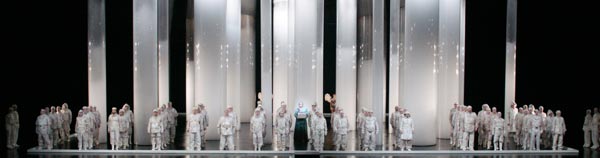
For those who want to check out the scores, some of Verdi's manuscripts are on display in the China National Museum, or they can go to NCPA for its extravagant productions. So far, it has done La Traviata, Un Ballo, Otello, Nabucco, Rigoletto and, in concert form, Aida. "Nobody beats NCPA in China in the scale of a production," says Li Cheng, an opera critic. "But it is a giant standing on the shoulder of previous generations." One of these pioneers is Qian Shijin, who presented the China premieres of several Verdi works in Shanghai.
Li cites spinto soprano He Hui as a major Chinese proponent for Verdi. After making rounds of the world's greatest opera houses, she returned to China in Un Ballo and Aida, wowing her home audience with superlative delivery of Verdian grandeur.
Related:
Oil painting museum opens in Beijing
Autumn HK auction to feature contemporary art




Copyright 1995 - . All rights reserved. The content (including but not limited to text, photo, multimedia information, etc) published in this site belongs to China Daily Information Co (CDIC). Without written authorization from CDIC, such content shall not be republished or used in any form. Note: Browsers with 1024*768 or higher resolution are suggested for this site.
License for publishing multimedia online 0108263 Registration Number: 20100000002731