

 Comments
  Print
Print  Mail
Mail  Large Medium Small
 |
|
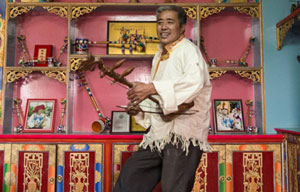
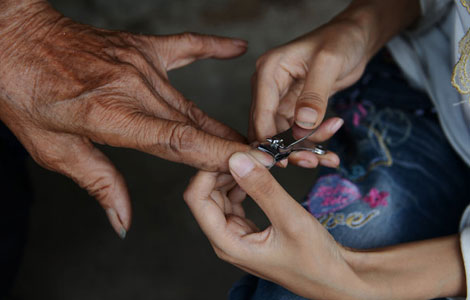
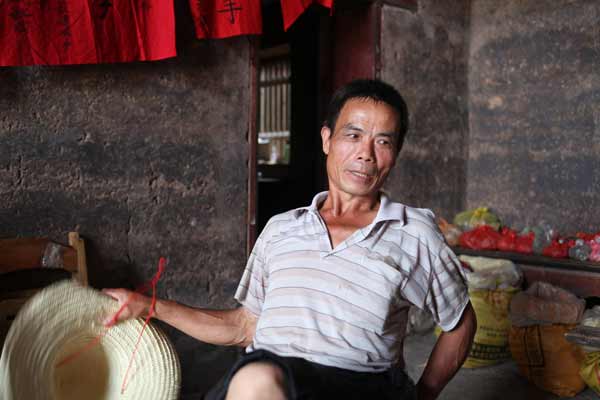
Zhao Ruming, 68, is an inheritor of Yao medicine in the mountainous village Nadui in Lipu, in the Guangxi Zhuang autonomous region. Photos by Huo Yan / China Daily |
Ethnic medicine is fast disappearing in China. Li Yang visits Nadui village in the Guangxi Zhuang autonomous region, to find out more about medical tradition.
Nadui village in Lipu county in the Guangxi Zhuang autonomous region is one of the few Yao villages left in China where ethnic medical traditions are still practiced.
The village, founded between 1862 and 1874, is surrounded by the Nadui Mountains to its east, west and north, and is home to about 100 families. It grew as people from neighboring regions came to it, fleeing from wars since the late Qing Dynasty (1644-1911). Today it is home to 302 villagers from four ethnic groups, most of them ethnic Yao people.
Almost all the older people in the village are masters of Yao medicine, which the Yao people developed over their long history of mountain life.
Yao doctors think there is a delicate balance not only in human bodies, but also between human bodies and the natural environment. Once the balance is disturbed by internal or external factors, they fall ill.
Yao people do not have their own written language. Yao medicine and medical skills are passed down through generations orally and via picture books.
Zhao Ruming, 68, and 55-year-old Feng Jinding are the two most famous Yao doctors in the village. The inside walls of their neighboring two-story buildings are covered with banners of various shapes gifted by patients from across the country. Some of the red banners have already faded to white.
Li Chenglan complained her husband Zhao had gone into the mountains to collect herbal medicines without telling her again. Mobile phones do not work because of the poor signal.
"Sometimes he stays in the mountains for several days. He is obsessed with the medicines," sighs Li, who married Zhao in 1967 and has three sons and one daughter.
"None of my kids are interested in medicine as much as their father. I am afraid the family tradition will disappear from this generation."
Yao doctors treat their illnesses on their own. According to Li, her husband has been bitten by poisonous snakes three times when he was in the mountains. "He managed to treat himself and walk out of the mountains safely."
Yao doctors diagnose by looking, listening, questioning and feeling the pulse of the patients, very much like in mainstream traditional Chinese medicine.
Nails, palms, tongue, ears, nose, eyes, face, urine and excrement are supposed to be connected with the internal organs and are important indicators of potential symptoms, according to Yao doctors.
They use needles, animal bones, eggs, wormwood and cupping jars to massage or scrape parts of the patients' bodies as a treatment.
Fire smoke from burning certain herbs and bath water boiled with certain herbal medicines are both indispensable external treatment materials.
Related:
Members of the Heiyi (black-clothed) Zhuang ethnic group still maintain their traditional lifestyle. But villagers worry it is fast disappearing. More...
For more China Face, here




Copyright 1995 - . All rights reserved. The content (including but not limited to text, photo, multimedia information, etc) published in this site belongs to China Daily Information Co (CDIC). Without written authorization from CDIC, such content shall not be republished or used in any form. Note: Browsers with 1024*768 or higher resolution are suggested for this site.
License for publishing multimedia online 0108263 Registration Number: 20100000002731