

 Comments
  Print
Print  Mail
Mail  Large Medium Small
A valuable porcelain cup holder that was auctioned off in Hong Kong recently has a certain amount of controversy surrounding its true origins, as Zhang Zixuan explains in this detailed report.
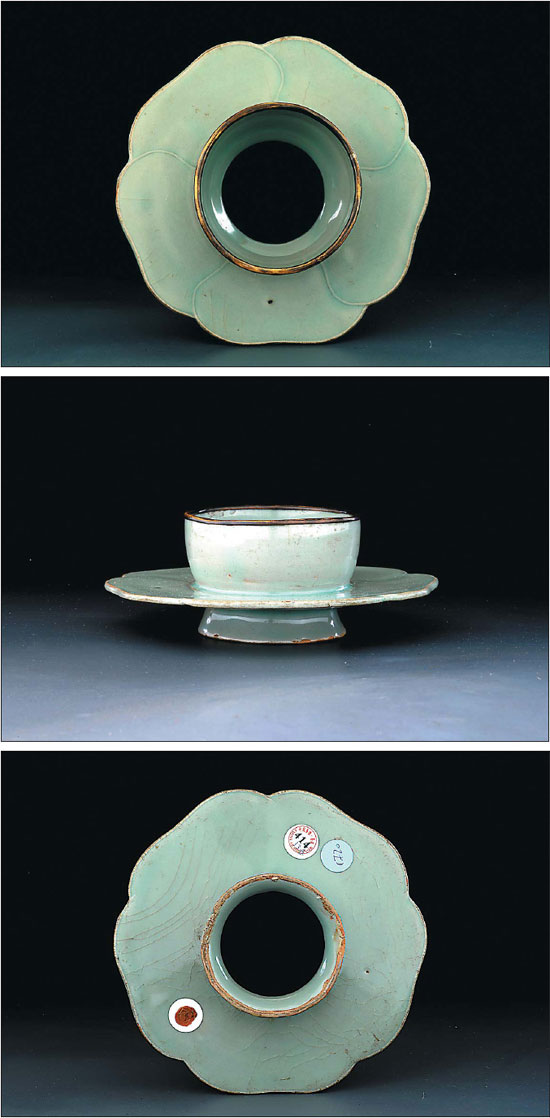
Four months ago, at the China Guardian Hong Kong Spring Auction for 2013, a porcelain "Korean Celadon Cup Holder" had a final sale price of $HK5,175,000 ($667,575), far above the estimated price of $HK600,000-800,000, or, for that matter, the highest price for Korean celadon ever.
The cup holder is a hollow, bowl-shaped cylinder with a flat five-petal flange and a flared foot. The celadon glaze was well distributed with a few big cracks. The upper rim was inlaid with copper.
The auction catalogue indicates that this Korean celadon, from a Japanese collector, is a fine 12th-century imitation of the celadon of China's Ru Kiln, one of five celebrated kilns during the Song Dynasty (960-1279), the others being the Guan, Ding, Jun and Ge.
|
From top: Many experts have considered the porcelain titled "Korean Celadon Cup Holder" a real work of Ru Kiln. Photos Provided to China Daily |
Then, in mid-August, one of the bidders' friend, Mao Xiaohu, who is the head of Beijing's Huaxia Evidence Identification Center for Ancient Ceramics and a ceramics expert, dropped a bombshell at a seminar dealing exclusively with the porcelain ware, to which the most authoritative experts and connoisseurs from China and South Korea had been invited.
What did Mao say? He revealed the porcelain ware's true identity by saying, "The cup holder is not a Ru Kiln imitation, it's the real deal."
Ru Kiln's rare works
The Ru Kiln was situated in what is today's Henan province and was the producer of porcelain for the imperial court during the late Northern Song Dynasty (960-1127), and famed for its glittering, exquisite celadon finish.
Curiously, the kiln only operated for 20 years, but, obviously, it is exactly this short existence that makes its products so dear. Today there are only about 80 pieces of its work in existence, of which a mere five belong to private collectors.
The cup holder is a stand for various types of tea cups, and many kilns, including the five major ones, used to make these.
One example can be seen on The Scholar Meeting (Wen Hui Tu), painted by the Huizong emperor (1082-1135) of the Song Dynasty, now in Taipei's Palace Museum. It shows a scene of a tea forum, where the white tea bowls are clearly supported by black porcelain stands from the Ding Kiln.
However, the type of Northern-Song flower-shaped cup holder from the Ru Kiln is a rare item, Mao says, and the only one even remotely similar to the auctioned one belongs to the Sir Percival David Foundation of Chinese Art, in the UK, in a permanent British Museum exhibition.
Mao says he believes the two cup holders are brothers, or sisters, from the same kiln - the Ru Kiln, in the village of the Qingliang Temple, Henan province.
His reasoning has been supported by science, in this case X-ray fluorescence, which showed that it tallied with porcelain samples from the ruins of the Qingliang Temple kiln.
Similar methods also suggest a marked difference between this ware and Korean celadon, where the amounts of ferrum, silicon, and potassium are markedly higher than those of this cup holder, indicating that they use two different kinds of materials.
The air bubbles show difference
This conclusion is seconded by a former director of the National Museum of Korea and a celebrated Korean celadon expert, Chung Yang-mo, who came to Beijing specifically to get a look at the cup holder.
The 82-year-old Chung, who has excavated hundreds of pieces of Korean celadon ware, comments, "Although porcelain making was introduced to Korea during the Five Dynasties and Ten Kingdoms period (AD 907-979), there are some techniques for cup holders of this kind that Korean celadon makers never learned."
The first discrepancy is the petal flange, which is almost horizontal, while similar flanges on Korean celadon are upturned at the edge, otherwise the flange would collapse during the firing process, he explains.
Second, Korean celadon contains more ferrum, which oozes through during the firing to add redness to the color. This cup holder on the other hand is a grayish green.
What is more important, however, are the air bubbles. In the Korean celadon glaze, they are mixed together in different sizes. But this cup holder has very even air bubbles that are distributed like pearls.
"That's why it's so lucid and beautiful," Chung continues enthusiastically, adding. "I feel honored just holding it."
Adding support to this is Choi Kun, the former director of the Gyeonggi Ceramic Museum in South Korea and a Korean celadon expert who accompanied Chung on the Beijing adventure, and who explains, "The porcelain body is more exquisite and was fired at a higher temperature."
The two specialists also point out that the copper inlay technique has to be Chinese because it had not been mastered by the Korean craftsmen of the time.
Lu Chenglong, the Beijing Palace Museum's Ancient Ceramics Department head, says the copper inlay was probably done much later by the Japanese, considering that the auction item is from a Japanese collector. He then speculates, "It's possible that the copper was inlaid to cover chipped areas on the upper edge, or to prevent chipping."
Nonetheless, he is quite certain that this ware is a product of the Ru Kiln at the Qing-liang Temple.
 |
 |




Copyright 1995 - . All rights reserved. The content (including but not limited to text, photo, multimedia information, etc) published in this site belongs to China Daily Information Co (CDIC). Without written authorization from CDIC, such content shall not be republished or used in any form. Note: Browsers with 1024*768 or higher resolution are suggested for this site.
License for publishing multimedia online 0108263 Registration Number: 20100000002731