Dinosaur village offers new body of evidence
"The most significant paleontological finds in the recent decade were carried out on the fossil sites in Liaoning province," Wang said.
Wang led a scientific research team in west Liaoning for 15 years excavating large quantities of amphibian, dinosaur, pterosaur, bird and mammal fossils.
Yet Wang was always attracted by Laiyang, a site of huge potential.
"Geological records show the excavation at Jingangkou was not finished, and the fossils were in a relatively small area, and covered a host of dinosaur species," Wang said.
"When I saw the geological fault in the mountains and the valley, I knew that this type of landscape preserves fossils."
The problem was, where to start.
The exact places where Tan Xichou and Yang Zhongjian excavated had been long forgotten.
Wang's team carried out extensive geological surveys and interviewed elderly residents hoping they would still remember Tan's excavation 90 years ago.
During the search, the team found a site full of broken dinosaur bones - which they call the second site - and they started the excavation.
One of the aims of this new excavation is to find new species, Wang said.
The nasal features of Tsintaosaurus is one such question.
Previous research indicated the nose of Tsintaosaurus was directed up, different from other known lambeosaurids, a genus dinosaur that lived about 76 to 75 million years ago in the Late Cretaceous period.
But tests on Tsintaosaurus, which is currently stored in the Paleozoological Museum of China, show the nasal feature differing from the research, Wang explained. He hopes the excavation can help solve the puzzle.
Also, Wang hopes to uncover a specimen of Tanius sinensis from the Late Crustaceous period.
The only skeleton is stored in Uppsala University, Sweden.
Wang's work in Laiyang started as early as 2008.
But site conditions held back excavation as Wang tried to protect exposed fossils.
When Wang arrived at the site, the fossilized bones exposed to air had cracked and they had become fragile and powdery.
After spending a harsh winter in Laiyang with the fossils, Wang found that the fossilized bones cracked due to the change of temperature.
"So, if we can keep the fossils from freezing, they will be preserved in better shape."
In 2009, the city government of Laiyang became involved in protection of the site and its fossils and provided facilities and personnel support for the team.
So why not just move the fossils away to preserve them in a laboratory?
"It depends on your purpose," Wang said.
If researchers need to dig the fossils out for scientific study it is better to ship them to the laboratory.
But for research purposes, it is better to keep them at the original site, he said.
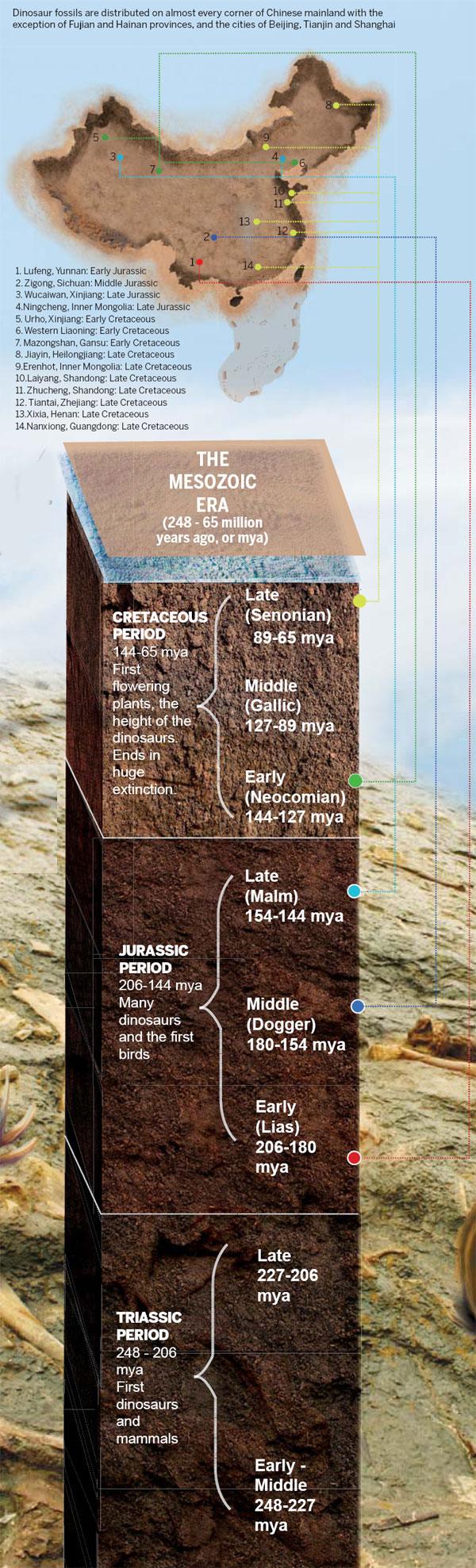
Related: World of dinosaurs that spans China
|
Source: Institute of Vertebrate Paleontology and Paleoanthropology at the Chinese Academy of Sciences. Guillermo Munro, Tian Chi And Feng Xiuxia / China Daily |