When parents crawl the Web
Mothers or fathers who scrutinize their children's friends and activities online - or go as far as to follow them covertly - often have children who do not feel comfortable opening up to them.
"Some parents think that being a parent gives you the right to spy on your kids," says Rob Blinn, a Beijing United Hospital and Clinics clinical psychologist, who specializes in parenting and attachment. "But why not develop trust with your kids from the very start?"
Parents who spy on their children risk damaging their trust, which can lead to other negative consequences, psychologists say.
Blinn advises building children's trust starting in preschool, so they feel comfortable talking to their parents about anything that bothers them. In parent-child relationships, he says, it's the parents who have a bigger responsibility to create trust.
Among China's predominantly only-child families, parents have a harder time emotionally letting go of their sons or daughters. Parents dedicate their lives to securing their only children's futures by providing them with things like quality education, their own apartments and trips overseas.
Since Chinese parents sacrifice a lot for their children, they also want a lot of control over them, says Sun Hongyan, head of the Children's Institute at the China Youth and Children Research Center.
But parents need to give children their own space, both offline and online, since this is a natural part of growing up, Sun says. Otherwise, she says, there will be endless conflicts in the family, and the child might never learn to be mature and independent.
Healthy parent-child interactions on social media can strengthen family bonds.
According to a study conducted by professors at Brigham Young University in the US teenagers who are connected to their parents on social media feel closer to them in real life.
"It lets parents know what their kids are going through, what their friends think is cool or fun, and helps them feel more connected to their child," Sarah Coyne, the study's lead author and associate professor at the university's department of family life, says.
Social networking sites also give parents more opportunities to offer positive feedback or show affection, Coyne says.
"Your kid might post a picture, and you might show support by liking it or making a nice comment or a status update that does the same kind of thing."
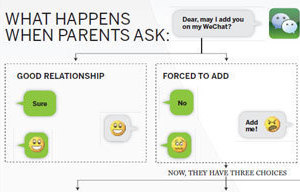
Although Wu Donghuang has barred his father from seeing his WeChat updates, Wu says their regular text and voice messages have brought them closer. He says that their online exchanges are more casual than phone conversations and make his father seem more like a friend than a parent.
Of course, Wu still has not admitted the real reason it has been almost a year since his dad saw his son's last status update.
Xu Lin contributed to the story.
|
 |
 |
| Family networks | Tips for parents |