Comments
  Print
Print  Mail
Mail  Large Medium Small
A strong group of provincial writers makes literary sense of tradition that comes crashing into a modern world.
Writers from Shandong province, where Confucius was born, brought the freshness of the seacoast to the 2013 Beijing International Book Fair that wrapped up on Sunday.
Following Henan-born writers, the Shandong writers were the second group to be highlighted at the book fair, one of the world's biggest gatherings of books and writers.
 |
|
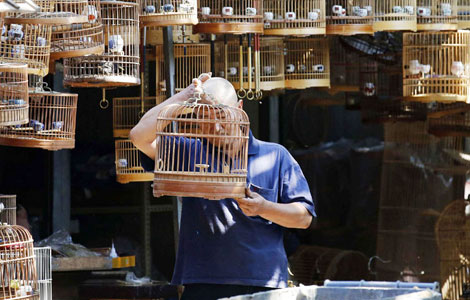
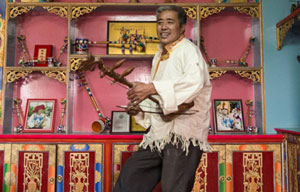
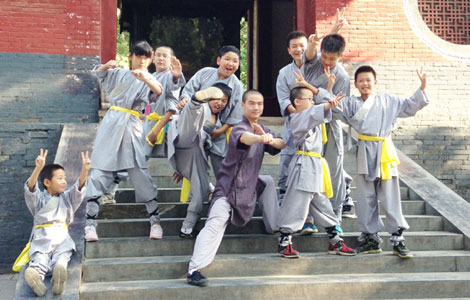
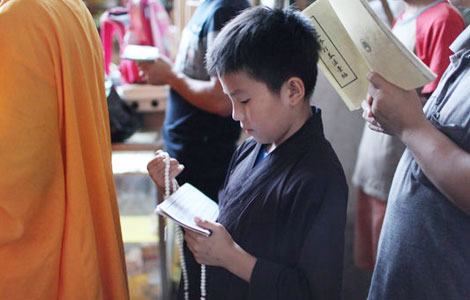
The Beijing International Book Fair is one of the world's biggest gatherings of books and authors. The five-day event ended on Sunday. Photos by Zou Hong / China Daily |
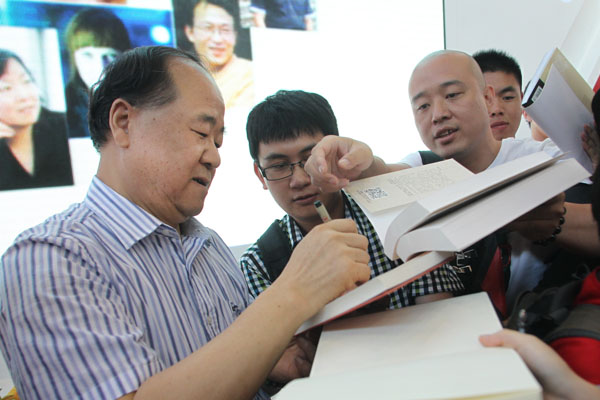
Mo Yan, Nobel laureate in literature in 2012, was among the Shandong writers. He often refers to the folk tales passed down through generations in his hometown as an important literary source for his own creations.
"People say Chinese writing has no tradition of magic and fantasy, but I can easily give an example of my fellow Shandong writer of the Qing Dynasty (1644-1911) Pu Songling, from whom I learned much," Mo told a group of German writers who came for literary exchanges on Sunday.
 |
|
Nobel laureate Mo Yan is one of the Shandong authors highlighted in this year's Beijing International Book Fair. |
Besides being deeply rooted in rich folk stories and a long history of traditional writing, established Shandong writers like Zhang Wei, author of The Ancient Ship and You're On the Highland, are good at recording the changes of rural China — in a realistic style influenced by prevailing Confucian aesthetics in morality and values, says Li Yeping, a literature professor and a woman Shandong writer.
Quoting Zhao Defa's Buddhist writing as an example, Beijing Normal University's Chinese literature professor Zhang Qinghua says Shandong writers are widely found to have "massiveness and sharpness".
The former is because they've always been dealing with the heaviest and most fundamental topics of all, the land and farmers, and the sharpness comes from their shrewd insight into China's transformation from an agricultural civilization into an industrialized society, Zhang explains.
Regarding Shandong writers' critical analyses of the complications of rural culture, Zhang says they've undertaken ethical responsibilities.
At the book fair, Zhang Wei, also chairman of the Shandong Provincial Writers Association, led a group of younger writers from his hometown to introduce them to the capital's literary scene.
Some are domestic literary-prize winners, some have already published several books.
Most of the younger writers have job experiences in other realms including medicine, law enforcement and mining.
And more women writers are catching the critics' attention.
Veteran writer Liu Qingbang, author of The Sacred Wood, believes he sees little hint of feminine writing in Shandong writer Ai Ma's works.
"Ai Ma's writing is sharp and precise like men's," Liu says.
Literary critic Qiu Huadong sees the same in writers Dong Zi and Wang Xiumei, observing that they are humorous and good at a wide range of social topics.
"Members of the Shandong group are heavily under Confucius' influence. They're engaged in the society and their writings are very relevant," Zhang Wei says.
"The other thing that makes the group, including the younger ones, unique is that they're very alert to problems they see. At a time when the society is money-driven and fickle, it's hard to find people looking for solutions and truths," Zhang Wei adds.
"Real writers are rarely professional. Think about the masters. How many of them write for a living? You should always write for the impulse and emotions you can't contain, not the market, publishers or the payment. That's one thing that makes Shandong writers the most promising crew, they generally have other occupations and don't get tired of writing."
"Big animals have calm faces. It's the same with writers," Zhang Wei says. "Shandong writers are better at this, they're more diligent and grounded. For writers, especially the younger ones, they should be careful not to be too smart and speculative."
Critic Qiu, who is also editor of an important literary magazine in China, says he noticed Shandong writers are on a rise because of the efforts by its provincial officials and writers' association.
"If the following decade has a chance to see the rise of a world-class Chinese literary work, it will be in Shandong," says An Boshun, chief editor of the Beijing center of Hubei Changjiang Publishing Group.
He says two conditions will guarantee success for Shandong writers.
One is their ability to endure the loneliness and constant inquiry into their field of writing. The other is that Shandong, Confucius' birthplace known for its great attention to traditional values, has seen a controversial separation from old-school ethics to meet modern-day rules.
|
|
|




Copyright 1995 - . All rights reserved. The content (including but not limited to text, photo, multimedia information, etc) published in this site belongs to China Daily Information Co (CDIC). Without written authorization from CDIC, such content shall not be republished or used in any form. Note: Browsers with 1024*768 or higher resolution are suggested for this site.
License for publishing multimedia online 0108263 Registration Number: 20100000002731