Seeds of hope
 |
|
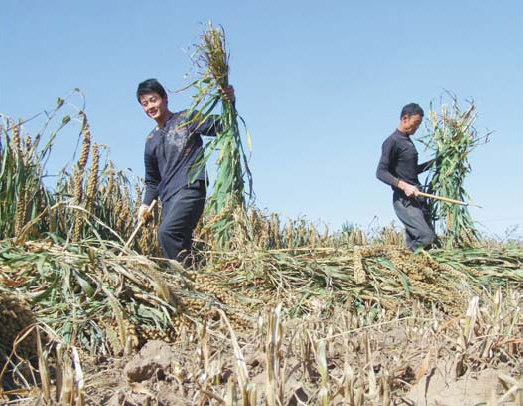
Farmers harvest millet in Aohan Banner. Provided to China Daily |
Cultivation by hand

In such places as Zhasaiyingzi village, humans and livestock cultivate the yellow millet that bristles on terraced slopes.
Farmers strictly adhere to the Chinese lunar calendar. If it rains before April, they plant corn. If it rains before late June, they plant millet. If aridity persists, they plant buckwheat.
Shi Xiuzhen says she has known this rule of thumb all her life. The 51-year-old has followed it every year, without wondering why.
Scientists have determined local ancestral wisdom boosts harvests, even during severe droughts.
"Rainfalls before April indicate more precipitation will fall that cultivation season, so corn is planted because it needs more water than millet," deputy director of the banner's agricultural bureau Xu Feng says.
"Buckwheat can survive with almost no water."
There are 21 kinds of miscellaneous grains grown on more than 660 hectares belonging to the Huilong Agricultural Cooperative. The cooperative is the larger of Aohan's two organic farming bases. It expanded from 330 total hectares last year to 800.
"We want to use more modern methods but are often forced to maintain traditions," cooperative manager Kong Fanjun says.
Seeding machines can't be used on slopes steeper than 15 degrees. So half of Aohan's 27,000 hectares of millet are cultivated in traditional ways.
Traditional - and organic
But old farming techniques are winning new appeal.
"Urbanites want organic food," says Shi, who's a cooperative member.
"These crops are popular. And we save by not buying chemical fertilizers, herbicides and pesticides."
Three donkeys plow her fields. She uses lights and organic insect repellents.
The sheep she raises bring in 50,000 yuan ($8,170) a year, plus manure.
One hectare can produce 3,700 kilograms of organic millet and up to 6,000 kg if chemicals are used. But the price is higher for greener goods. Last year, 1 kg of ordinary millet sold for 3.6 yuan in the local market, while organic varieties sold for 2 yuan more.
Shi's family earned nearly 50,000 yuan from millet last year - 10,000 yuan more than before she switched to organic in 2007.
Kong, the cooperative manager, says 1 kg sells for about 20 yuan once processed and put in gift packages.
Annual sales of the cooperative topped 10 million yuan last year, he estimates. Most produce was sold to Beijing and northeastern provinces.
"Prices will go up as more people become health conscious," he says.
For more Eco-China, here
For Organic Life, here
|
|
|
| Going nuts | Sticking up for sustainability |