Comments
  Print
Print  Mail
Mail  Large Medium Small
 |
|
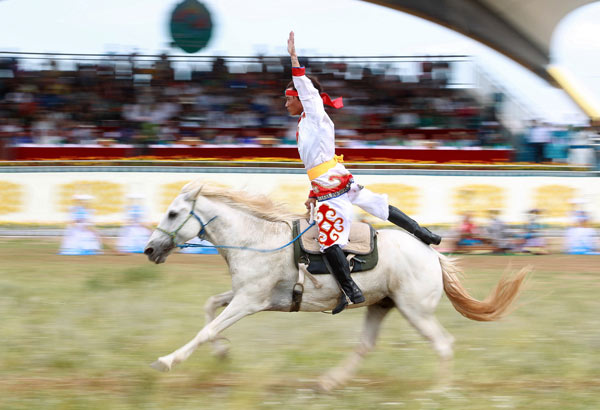
A man displays his skill on horseback at a recent Nadaam held in Xilinhot in the Inner Mongolia autonomous region. |
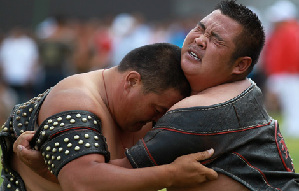
Traditional Mongolian wrestling, called bokh in the local language, symbolizes strength and courage. It's the most popular sport at the festivals.
One of its defining features is the dance the combatants perform as they enter or exit the arena. The dance has both a physical and spiritual aspect; it helps the wrestlers show their respect for nature and their opponents, while providing a good warm up for the muscles before the bout begins.
Bokh, which means "strength, solidarity, durability", is part of the local culture. The people learn the intricate moves during childhood when they begin wrestling on the grassland.
With a history of nearly 2,000 years - bokh was designated a military sport by Genghis Khan - bokh's development has been shaped by the natural environment.
The wrestlers, known as bokh qin, dress in a special waistcoat called a jodga, usually handmade from cow and camel hide or deerskin. Metal studs made of copper or silver are set in the waistcoat to provide convenient handholds for the wrestlers. They also absorb some of the impact when competitors are wrestled to the ground.
Each jodga is decorated with dragons, phoenixes, lions, tigers, elephants and other designs that equate the skill, strength and bravery of the bokh qin with those of the animals depicted.
 |
|
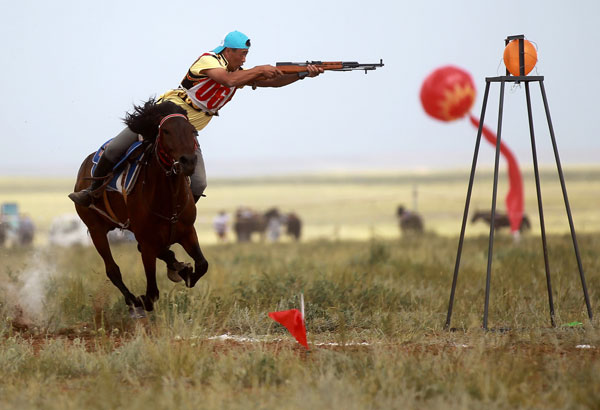
Photo by Cui Meng/China Daily |
Bouts are held in a simple, solemn fashion. Because it is impossible for a person to fight alone, there must always be an even number of participants, 95 percent of whom are nomadic shepherds. The field can number as many as 1,024 participants. When the bout begins, the wrestlers wave their arms and move into action, imitating the movements of lions, deer and eagles.
Bouts are usually held on open fields and follow traditional rules, which means there are no limits on the duration of the bout or the weight of the competitors, a practice that leads to the occasional mismatch. The symbol of honor is the jiang ga necklace, which consists of a ring adorned with five differently colored cloths. Only wrestlers who have won the competition three times are permitted to wear the jiang ga.
Ujirbaatar, a young bokh qin from East Ujimqin Banner in the Xilin Gol League, began his professional career seven years ago. The 25-year-old has participated in as many bouts as possible this year, but was unable to claim victory in the Xilin Gol League's Nadaam, which featured 140 competitors. There was no jiang ga for him this time around.
When a wrestler wins a championship, he is eligible to wear the necklace. Every further win sees more ribbons added to the ga, or the ring section. The greater the number of victories, the greater the number of ribbons the wrestler sports.
Historically, whenever important feasts were held, wrestlers were invited to join the fun. The sport was once a key way of deciding candidate rankings in imperial martial exams and, even today, outstanding wrestlers command a huge amount of public respect.
Related:
Mongolian Clothing Festival held in Ulan Bator
Naadam Festival commemorating Genghis Khan opens in Inner Mongolia
|
|
|
| Naadam Festival in Xinlin Gol | Naadam fair opens in NW China |




Copyright 1995 - . All rights reserved. The content (including but not limited to text, photo, multimedia information, etc) published in this site belongs to China Daily Information Co (CDIC). Without written authorization from CDIC, such content shall not be republished or used in any form. Note: Browsers with 1024*768 or higher resolution are suggested for this site.
License for publishing multimedia online 0108263 Registration Number: 20100000002731