

 Comments
  Print
Print  Mail
Mail  Large Medium Small
When was the last time you read a poem? Is there someone in your social network who calls himself or herself a poet?
At the Qinghai Lake International Poetry Festival in August, about 150 Chinese poets got together to celebrate.
"At any point in our history, poets belonged to small groups. The difference is the number of people who love poems," says Shu Cai, a poet and researcher at the Chinese Academy of Social Sciences.
In the 1980s, poets in China were big stars and trendsetters. The whole of society was obsessed with poems and poets could make a living, thus emerged big names like Su Ting, Hai Zi and Gu Cheng.
"Now poets have their own specific circles. Only those who love poetry to death will write it. Poet is not a profession, but a kind of mindset," Shu says.
Yang Ke, chief editor of Yearbook of Chinese Poetry, says it's common for poets to have a salaried job and only write poems on the side, because in China, they cannot make a living just writing poems.
"Many poets in Guangdong province are businessmen. Some are so rich that they are on the billionaire list," Yang says. He is also vice-president of Guangdong Writers Association.
According to Yang, poets come from various fields. Some are professors at colleges like Xi Chuan, a professor at the Central Academy of Fine Arts; some are curators like Ouyang Jianghe.
From office workers to bar owners to policemen, poets can be anyone hidden among the crowd as long as they love poetry, Yang adds.
Although it's common for Chinese poets to publish their poems out of their own pockets instead of being paid by publishers, in recent years, there are more translated poems from other countries in the market.
"This year alone, I've received several offers from publishers who have requested me to translate foreign poems into Chinese," says Shu Cai, a poet and French translator.
What's the attraction of foreign poetry compared to their Chinese counterpart?
The topics of Chinese poems have changed from society issues to private emotions, compared to the height of poetry 30 years ago, says Huang Shangen from Literature, a weekly magazine.
"Poets today are more concerned about things around them and about their inner minds. In contrast, poets 30 years ago used to ask questions about society and played the role of prophets. That's readers' expectations toward poets, to ask questions and to offer directions," Huang says.
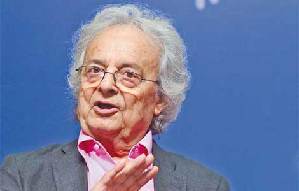
What Huang says echoes the thoughts of Arab poet Adonis whose poems are well received in China.
Adonis says although there are many Chinese poems, there is huge room for expansion.
|
|
|



Copyright 1995 - . All rights reserved. The content (including but not limited to text, photo, multimedia information, etc) published in this site belongs to China Daily Information Co (CDIC). Without written authorization from CDIC, such content shall not be republished or used in any form. Note: Browsers with 1024*768 or higher resolution are suggested for this site.
License for publishing multimedia online 0108263 Registration Number: 20100000002731