Robot classes set students up for future careers
 |
|
Provided to China Daily |
Zheng Jianchun, a robot class teacher of Beijing No 12 Middle School, says when he started teaching robot-related knowledge in late 1990s, there were few students who showed interest, but now students are very passionate about robot classes.
In his school, there are required robot courses for senior students, and optional courses and clubs for junior students. The classes always get an overwhelming response.
Students benefit a lot from those classes, says Zheng, who in 2010 authored a best-selling book titled Structure and Program of a Robot based on his teaching experiences.
"By designing and controlling a robot, students can better understand knowledge acquired in courses such as physics and mathematics, and then learn to apply the knowledge in real life," Zheng says.
Ethan Danahy, an engineering education specialist from Tufts University, Boston, Massachusetts, the United States, agrees with Zheng.
He thinks the current problem in education is the lack of motivation among students, and the robot is a great product to help change that.
"When students work with their hands, they are engaged, and are inventing, creating and building new solutions to problems," Danahy says.
Many of Zheng's students are admitted into top-level universities, such as Harvard, Peking and Tsinghua, majoring in engineering and computer science, among others.
But Wang Jihua, the robot teacher with the prestigious school in Shanghai, says that is not the reason to use robots. Robot classes make students more creative and cooperative, and inspire their interest and sense for science, rather than to help students score better in examinations, Wang says.
"I think the most beneficial thing a robot class can give to students is to make them realize whether they love science or not," Wang says.
Wang himself has led his students to participate in several robot-designing competitions, but he says not all schools are able to have students exposed to such activities, because of financial constraints.
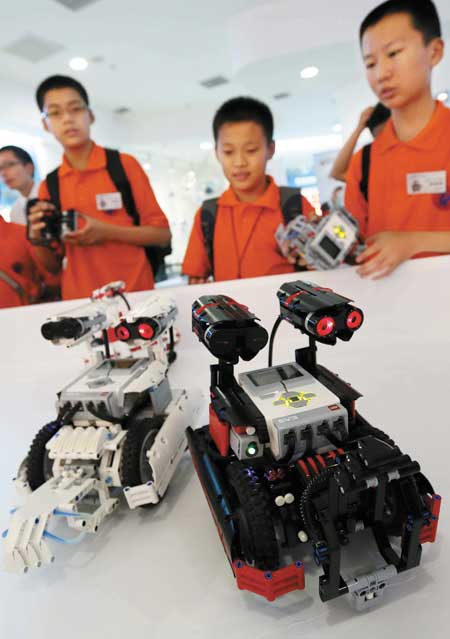
A set of educational robots, usually used by a group of four to six students, costs thousands of yuan, and only well-to-do schools can afford it. Wang's school has spent 210,000 yuan ($34,000) on its robot classes this year.
|
|
|
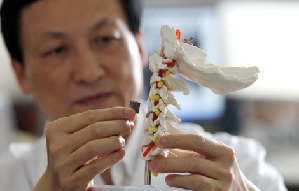
| Printed bones |