

 Comments
  Print
Print  Mail
Mail  Large Medium Small
A family home
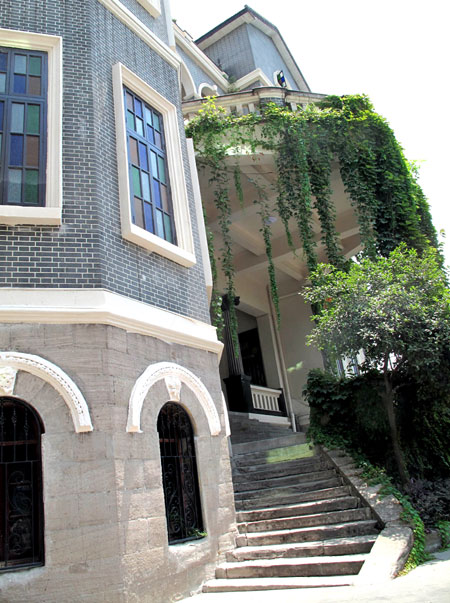
Ding Huilong, a 73-year-old retired high school teacher, has closer ties with the old embassy sites than most people. Her family moved into the former Germany embassy, situated on Nanshan Mountain in the east of Chongqing, at the end of 1971 and stayed there for 21 years.
"My students loved coming to my home to use the library and practice their acting and singing," said Ding, recalling the old days. The former Chinese teacher added that the front yard of the house, which is now private property, served as a stage for her artistically inclined students.
One of her former pupils, Li Jia, often visits her old teacher. The middle-aged woman said she still likes to hike to the top of the hill to take a break and admire the stunning views of the Yangtze River far below.
"The house was fantastic for us teens, especially in the 1970s. The view from the balcony is great," said Li, who can clearly recall the layout of the building.
Ding keeps two snapshots of a tall blond-haired woman in her photo album. "She is the daughter of a German doctor, the original owner of my old home, the former Germany embassy," she said, before apologizing for her inability to recall the name of the woman, who visited the site in the late 1980s.
Ding doesn't speak German and the "German woman" didn't speak Chinese, but the visitor wrote her address on the backs of the photos and sent them to Ding's family in the hope of maintaining contact, however slight, with her Chinese friends in the pre-Internet age.
Although the handwriting is difficult to decipher, Ding and her husband covered the backs of the photos in clear tape to preserve the contact details.
Unbreakable links
The former Australian legation, whose visitors included its former prime minister Bob Hawke and his wife, is now the administrative office of E'ling Park, a large public space in Yuzhong district.
"The sites are links between Chongqing and the rest of the world," said Zhou from the research center. Zhou said the affection that exists between China and other countries was forged by history and the shared experience of difficult times.
Oxford University's Mitter said the sites are reminders of a crucial time in the history of the world. He said it's important for Chinese people to remember those times and remember that, along with the Chinese Communist Party and foreign allies, the Kuomintang government played a role in defeating the Japanese.
"It's important to preserve the historical sites in Chongqing, the places that recall its role as the wartime capital of China. The politics of the Cold War in China and the West led to this piece of history being forgotten. It is important to remember the role of Chiang Kai-shek along with that of Mao Zedong - and Chongqing was the capital where China's Kuomintang government resisted Japan, in alliance with the CPC," he wrote. Mitter suggested that former allies and enemies need to visit Chongqing and understand the importance of the city's role in resisting the invasion of China.
Zhou echoed Mitter's opinion. "The only way to gain permanent peace is to liquidate the historical debt thoroughly. One of the important reasons for China to preserve these wartime sites is to clear up the issues of history with Japan."
Zhou also believes that Chongqing witnessed the rise of modern China: "From the diplomatic point of view, China became a large, strong country, one of the four world superpowers, along with the United States, the United Kingdom and the Soviet Union. It was a difficult beginning in the process of building a strong country from a weak one." Huang Xiaodong, executive member of the Chongqing Historical Society, applauded the preservation of wartime sites.
"These sites make history manifest and they are reminders of a truly vivid past. Restoring the sites will create an atmosphere that will help people today understand that history vividly and thoroughly," he said.
Gao Hong, deputy director of the Institute of Japanese Studies at the Chinese Academy of Social Sciences, acknowledged that the wartime sites are an important element in developing the relationship between the two countries.
"We'll learn from history and face the future," Gao said, adding that a correct historical record is essential for an accurate understanding of the past.
"In addition to the written and broadcast media records, historical sites are an important part of the material evidence. They are reminders to the post-war generations not to forget the past," he said.
The last word goes to Wan Xin. For her, the experience of working in a building that played such a vital role in history is an uplifting one: "Whenever I step into the hallway, I feel proud of the rich and honorable history. Even the smell of the old wood is exciting. Maybe I'm being affected by the magic of history?"
|
|
|



Copyright 1995 - . All rights reserved. The content (including but not limited to text, photo, multimedia information, etc) published in this site belongs to China Daily Information Co (CDIC). Without written authorization from CDIC, such content shall not be republished or used in any form. Note: Browsers with 1024*768 or higher resolution are suggested for this site.
License for publishing multimedia online 0108263 Registration Number: 20100000002731