Comments
  Print
Print  Mail
Mail  Large Medium Small
 |
|
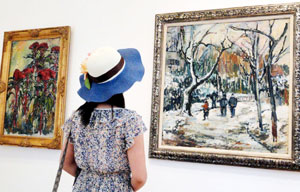
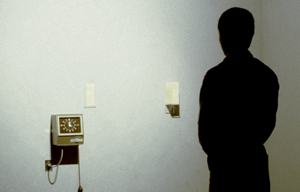
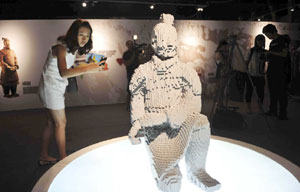
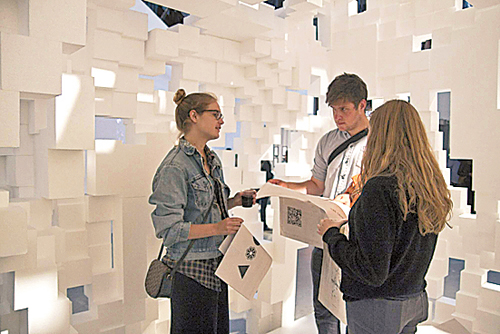
Visitors take in The Crystalline World artwork by Thom Faulders and Lynn Marie Kirby at San Francisco's SOMArts Cultural Center. Kelley Bennett / for China Daily |
An art exhibition is exploring what the world would be like if the Pacific Ocean was placed in the center of it. Kelly Chung Dawson reports in New York.
A Western-centric view of the world has long dictated the often-repeated phrase of the Gold Rush days - "Go West" - refers to California, and those traveling to "the East" had bypassed the other coast and were en route to China. But a new exhibition poses the question: What if the Pacific Ocean was the center?
"So much of our language is rooted in the legacy of colonialism and Western history, but today you see people who move between San Francisco and Shanghai more readily than between San Francisco and New York," says Justin Hoover, curator of the exhibition Electronic Pacific, at San Francisco's SOMArts Cultural Center. "Today, due to global digital telecommunication, one could redraw cultural maps to conceptualize the West Coast of the United States as the East Coast of the Pacific Ocean. New modes of communication can operate in a supra-national modality to swiftly redefine cultural norms."
Featuring 26 artists and split between two gallery spaces, Electronic Pacific includes eight artists with a focus on China. Tying the artists together is a theme of digital communication and the liminal space created by cultural mistranslation.
In Utilizing Google Translator, Guangzhou artist Xiaopeng repeatedly translates the rhetoric of Chinese politicians into English and back, until the words have become nonsense, the intended meaning lost to the limitations of technology.
Accompanying this work is a series of videos, in which the artist has translated the lyrics of hip-hop artists to highlight the potential for misunderstanding of another nation's pop culture.
Jenny Odell, a so-called "cameraless photographer", isolates objects, buildings and landmarks affiliated with trade and transport from all over the world using Google Satellite View. Stripped of the context of surrounding markers, the objects form a visual archive of unfamiliarity.
"These artists are pushing the medium of digital translation and communication to see where they fail," Hoover says. "With the ubiquity of cutting-edge technology in the art field now, we're all babbling together in an interesting poetic space. Technology doesn't necessarily always bring us together to connect; it also enables us all to speak louder. In many ways, everyone's just talking over each other. There's a deterioration of understanding at the edge of language and technology, a frayed edge that is both challenging and beautiful."
In a continuation of her work with the artists of China's Xiamen art reproduction village, Lizabeth Eva Rossof commissioned nine self-portraits by oil painters who make a living creating the frequently overlooked art that fills hotel lobbies, doctors' offices, and restaurants all over the world. The paintings created by the artists in Chinese reproduction villages provide 80 percent of the canvas art commercially available worldwide, Rossof says. Asked to turn their focus to themselves, the artists often struggled with the sudden creative freedom afforded by Rossof.
Working with a translator, Rossof spoke with the artists about their lives, which proved surprisingly familiar, she says. Like Rossof, some of the artists battle between the urge to create and the need to pay rent. Later, she watched professional translations of the videos of her interviews and realized that the discussions were more nuanced than she had realized at the time. Some of those interviews are presented in an accompanying 14-minute documentary titled Master Copy.
"I just wanted to see what would happen, what would it look like if someone who paints Mona Lisa all day long, had the opportunity to paint themselves," Rossof says. With all their training, these painters have often never thought of themselves as a possible well of inspiration or subject matter."
Western consumers rarely stop to think about the human hands that have been intimately involved with almost everything we buy, she says.
"Maybe the Pacific Ocean itself is the center, or maybe it's one of the centers," Hoover says. "Maybe there's a multiplicity of centers. The language is changing as the way we think about the world changes and directionality becomes less important."
An Xiao Mina, a digital artist who has worked in both China and the US, explores the connections between animated online "gifs" (short animated images that are increasingly popular on the Internet) and the ancient cave paintings of Frances's Lascaux Caves, which were intended to be viewed under the shape-shifting glow of torchlight.
Although an exhibition like Electronic Pacific can be described as an attempt to bridge gaps between the East and the West, Mina believes that the "bridge" analogy is increasingly less relevant in describing cultural exchange.
|
|
|


Copyright 1995 - . All rights reserved. The content (including but not limited to text, photo, multimedia information, etc) published in this site belongs to China Daily Information Co (CDIC). Without written authorization from CDIC, such content shall not be republished or used in any form. Note: Browsers with 1024*768 or higher resolution are suggested for this site.
License for publishing multimedia online 0108263 Registration Number: 20100000002731