Mark my words

Some Chinese have the antiquated notion that carving their names in historical sites can make them immortal, but with new technologies it may bring them notoriety. Eradicating such behavior, however, will take a change of national mindset.
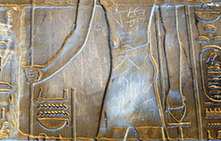
A recent photo from a temple in Luxor, Egypt, has shocked China. Inscribed in Chinese on a 3,500-year-old stone is: "Ding Jinhao was here."
The photo was taken by a Chinese tourist who, with his fellow travelers, was so ashamed at the defacement of an ancient relic by a countryman that they tried to erase it. Failing that, he posted the photo on the Internet, triggering a nationwide wave of revulsion over the act.
Soon, the violator's parents came forward and apologized for their 13-year-old son, who they said cried all night long - over what he did or over his instant infamy, is not clear. As Ding is underage, talk of legal action has come to an end and his crude handiwork has since been successfully removed.
Ding is just one of millions of Chinese with a penchant for carving their names on places and objects of historical or cultural interest. Take a look at any section of the Great Wall and you'll understand the magnitude of the problem. On some busy parts of the Wall every brick is crammed with signatures.
If you have to blame this on one person, it must be Sun Wukong, aka the Monkey King. In the classic novel Journey to the West, written in the 16th century, the mischievous monkey leaps into the sky to prove his ability to cross thousands of miles in one jump. At some faraway location he carves his name to prove his presence.
 |
Upon hearing of the monkey's feat, the Buddha shows his hand - and there is the naughty animal's inscription, "Wukong was here" - showing that the vast space covered by the monkey was but an inch on the Buddha's palm.
Since then, it appears that defacing famous property has been a favorite pastime of some Chinese. One can equate it with vandalism, but it may not occur to the perpetrators that they are damaging something they do not own.
Graffiti may be a better term. Like a graffiti artist in a Western country, a Chinese inscriber such as Ding essentially sees his name as a worthy addition to an existing statue or noted structure, regardless of what others may feel about it.
There are differences of course. Graffiti appear mostly on walls with little historical value, and vary in content; the engravings of Chinese tourists can appear on anything and tend only to record names, sometimes followed by "was here", "loves so-and-so" or "such-and such rules" - in other words, it's more childish than most graffiti.
Related:
Tourists asked to be on best behavior
Mannerly advice issued to tourists
For more x-ray, here