After strike one
 |
|
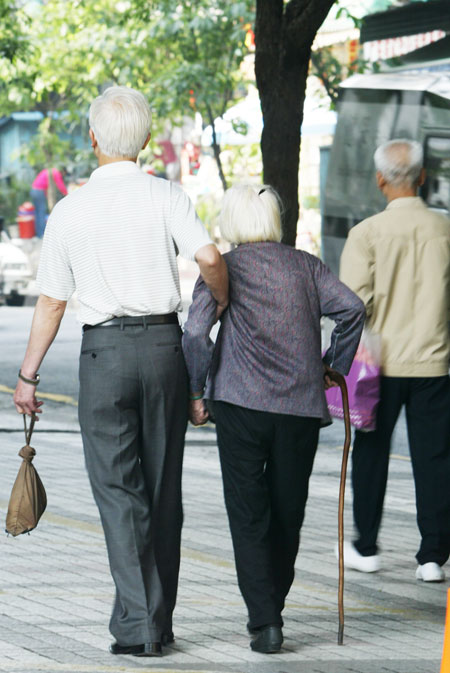
Strokes are one of the leading killers among China's elderly population. Zhang Heping / Asia News Photo |
"In fact, strokes can be treated if detection and treatment happen quickly," says Wang Yongjun, vice-president of Beijing Tiantan Hospital, noting the condition needs to be treated within three hours after symptoms start appearing.
The most effective therapy for ischemic stroke, the most common kind, is clot-busting drugs that break up the blockage and allow blood and oxygen to flow back to the affected parts of brain. Such drugs must be administered within three hours after the stroke.
But, there are many patients who do not get this immediate help, so only about 5 percent of stroke victims are benefiting from this therapy at present.
"Because there is poor awareness and because the emergency systems outside of hospitals are not adequate, early prevention and treatment for strokes are still lagging," says Gao Ying, a professor with the Beijing Dongzhimen Hospital affiliated to Beijing University of Chinese Medicine.
While the average response time for stroke treatment in developed countries in 2003 was about 5.6 hours, in China, the response time was about four times longer at 20.1 hours in 2006, according to Gao.
"The longer the patient waits for treatment, the greater the dangers he faces. More often than not, the patient and his family do not know what to do when a stroke occurs," Wang says.
"There must be more public education," Yang says. "Medical bodies and communities should organize more such initiatives."
In China, disability caused by strokes is much more frequent than that from other diseases such as diabetes, heart failure, asthma and cancer. The mortality rate is four to five times that of Europe and the United States, 3.5 times that of Japan, and even worse than other developing countries such as India and Thailand.
The mortality rate is growing by 8.7 percent each year.
Scientists have been looking for more effective treatment for strokes and experts believe that the key is to transform lab research results into clinical practice.
According to Yang, basic clinical research has not been well grounded, despite a large number of papers published over the years.
"Lots of research has been done, but experiments on animals rarely prove workable on human beings."
Yang also notes that very little of lab research findings have been put to use in real clinical treatments.
Other scientists share his concern, and this became a focus point at the International Symposium on Cerebral Blood Flow, Metabolism and Function and the International Conference on Quantification of Brain Function with PET, which was held last week in Shanghai.
One of the answers may be a change in the research methodology, according to Yang.
"Interdisciplinary studies may help sort out the problem. And related research has to be refined into various aspects including neural protection after stroke, regeneration of nerves and blood vessels, and new technology to assist rehabilitation.
"Most importantly, we have to make sure that research findings find a place in real treatments," he says.
WHAT YOU NEED TO KNOW
Stroke is the rapid loss of brain functions when there is an interruption of the blood supply to the brain. It can be due to ischemia caused by blockage, or a hemorrhage. Ischemic stroke currently accounts for 80 percent of all strokes.
It is important for people to recognize the early signs of stroke and seek immediate treatment without delay.
All strokes happen fast, and symptoms appear suddenly. It's common for people to get more than one symptom at the same time, though not everyone gets all of the signs.
These are the signs to watch out for:
? Sudden numbness or weakness of the face, arm or leg, especially on one side of the body.
? Sudden confusion, trouble speaking or understanding.
? Sudden trouble seeing in one or both eyes.
? Sudden trouble walking, dizziness, loss of balance or coordination.
? Sudden severe headache with no known cause.