Comments
  Print
Print  Mail
Mail  Large Medium Small
 |
|
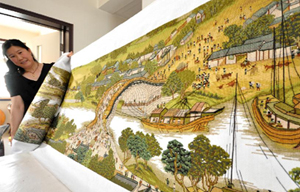
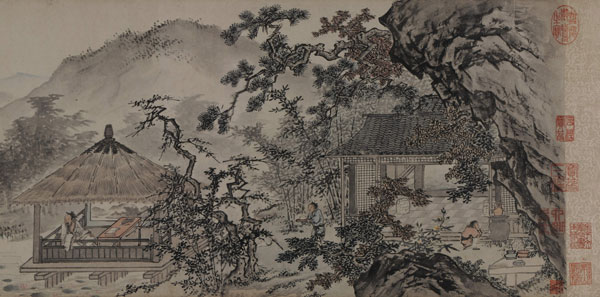
The Songya Villa, by Ming Dynasty artist Tang Bohu, will be on sale at the Poly Auction's upcoming spring sales. [Photo/China Daily] |
For the first time, Poly Auction's upcoming spring sales will pay tribute to the Chinese art scene's time-honored "literati painting".
Literati painting used to refer to artworks created by literati or scholar-bureaucrats, but it now also refers to artworks that convey a "literary mood", often in the form of a longing for nature and seclusion.
The art form originated in the middle of the Tang Dynasty (AD 618-907) and reached its climax in the Ming (1368-1644) and Qing (1644-1911) dynasties.
Chinese poets found spiritual resonance with nature and often use bamboos and mountains as their subjects. To express their philosophical reflections, they used freehand brushstrokes.
Led by spontaneous inspiration rather than skills, they care more about how their paintings feel than how they look.
Among the rare art pieces is the Mongolia Mountain and Water Map, which experts say was painted between 1524 and 1539. The 30-meter long imperial silk hand scroll is believed to be a fine combination of science and art.
The map marked 211 places from the Ming Dynasty's frontier Jiayuguan pass westward to Mecca of today's Saudi Arabia, with names that were transliterated from nine languages, including Mongolian and Greek.
It is arguably a proof of the fact that, Chinese's exploration of world geography had started long before Italian missionary Matteo Ricci's arrival in 1583.
More importantly, painted with a clear "green mountain and water" technique, the map has demonstrated admirable artistic value. It was influenced by the painting style of the Wu school, featuring a party of mainly Suzhou-based literati painters such as the well-known Tang Bohu.
A painting of Tang Bohu, typically evident of his longing for a secluded life, will also be on sale. The Songya Villa depicts Tang's companion Songya lying by his side while meditating in a riverside grass pavilion surrounded by green mountains and bamboo. The painting used to be owned by the Song Ziwen family, who were in control of China's financial power in the 1920s, possibly reflecting his longing for seclusion too.
On the contrary, literati painters now use historical figures as their painting subjects. Many of Fu Baoshi's artworks are based on the image of Qu Yuan, the patriotic Chinese poet. For example, Yun Zhongjun and Da Siming.
The introduction of new materials, techniques and ideas has enriched Chinese painting. Many modern literati works have incorporated Western realistic skills, such as oil painting. Chang Shuhong's Young Girl in the Street, for example, is believed to be clearly influenced by neoclassicism while incorporating a heavy Chinese flavor.
|
|
|

 Haven of Literature
 Xinjiang performing troupe presents shows in US
 Car pyramid sculpture unveiled in C China
 Italian artworks to be displayed in Taipei
Copyright 1995 - 2010 . All rights reserved. The content (including but not limited to text, photo, multimedia information, etc) published in this site belongs to China Daily Information Co (CDIC). Without written authorization from CDIC, such content shall not be republished or used in any form. Note: Browsers with 1024*768 or higher resolution are suggested for this site.
License for publishing multimedia online 0108263 Registration Number: 20100000002731