Knowing vaccines
 |
|
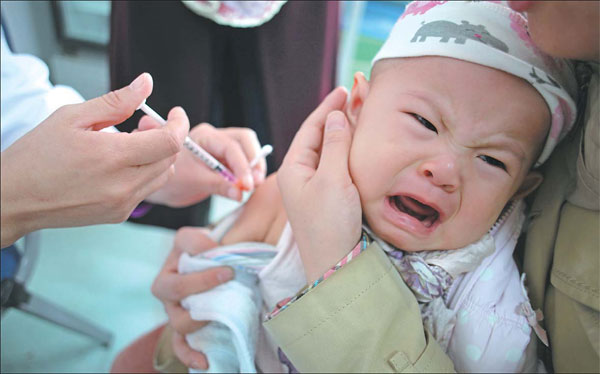
Medical experts say vaccines protect people against diseases and there's no reason to worry about their safety under medical direction.[Photo by Wang Jing / China Daily] |
Every Chinese child can get inoculated against the most common childhood diseases, but many parents are still unsure if it is the best thing for their baby. Liu Zhihua looks at the pros and cons.
Ever since free vaccinations became widely available in China from the 1970s, many dangerous diseases, such as polio and hepatitis B, have been eradicated or largely reduced. But for parents, it is still a confusing issue and many vacillate when it comes time to get their child vaccinated.
The country's vaccination system is divided into two categories at present. The first is mandatory vaccination, mostly free and using domestic vaccines under the National Immunization Program. The second is alternative vaccination, which parents must pay for.
Currently, there are 14 mandatory vaccines against 15 infectious diseases, and about 30 kinds of optional vaccines. There is also confusion about the difference between domestically produced vaccines and those that are imported; the only obvious difference is the price gap.
"I know the government requires children to get vaccinated, and I follow the doctor's instructions to get my child injected again and again," says Miao Miao, a middle-school teacher from Ankang city, Shaanxi province, who has a 1-year-old daughter. "But I'm not certain if all these vaccines are really good for her."
Xu Qiong, father of a 3-month-old boy in Beijing, is also completely perplexed, even though he works in a health service company and knows a little more about medical products than the average person does.
"My son gets vaccinated almost once every month. There are so many vaccines," Xu says. "I don't know which is the better choice, the free, more economical domestic vaccines, or the expensive imported ones."
According to the Ministry of Health, in 2011, the inoculation rate of children under the National Immunization Program was more than 90 percent.
Optional vaccines, such as the common influenza vaccine, are less successful, especially in the comparatively less-developed areas and among low-income groups, experts say.
Related: