Babies find 'home' in her arms
Lack of rights
China's adoption laws are strict: The regulations, which came into force in 1992, state that adopters should be childless, aged 35 or older, and capable of raising and educating the child. Moreover, anyone that adopts an abandoned infant, a child whose parents cannot be found or an orphan in the care of a social welfare institution, must register the adoption with their local civil affairs department.
Only if those conditions are met can an adopted child obtain hukou, China's national household registration permit. Failure to obtain hukou means the child has no right to the benefits enjoyed by permanent residents, including education and government-supported medical insurance.
Because she failed to understand the rules correctly, Lou didn't register any of the children she adopted. Fortunately for them, Lou's acts of kindness have won local acclaim and four of the children she adopted were granted hukou by special permission of the local government. The fate of the others is unknown, because Lou allowed other families to adopt them unofficially and there is no record of whether these "second adopters" registered the children with the authorities.
Unforeseen problems
Although, no one doubted Lou's motives, her acts of kindness unwittingly caused problems for the children in later life.
Aside from the problems concerning hukou, there is little chance that children who have been abducted or whose parents abandoned them, but later had a change of heart, will ever be reunited.
"If children are adopted unofficially, and not officially registered, their names will not be posted in public as required by law. That means that even if the real parents want to get their child back, reuniting them is almost impossible," said Zhang Zhiwei, a Beijing lawyer who specializes in child-trafficking cases.
Moreover, a lack of information about second adopters meant Lou faced tough choices about who should be allowed to "second adopt" the children. According to Zhang Caiying, her mother would often base her choice on the couple's manners, behavior and even their mode of dress. If she harbored suspicions about the couple's motives, she rarely had the chance to check on the child's subsequent welfare. "Many people will keep the adoption a secret. Some even move to a new city and start a new life there," said Zhang Caiying.
And the problems don't end there. "Even if they can contact the children, people such as Lou lack the rights or skills to supervise the second-adopted families," said the lawyer Zhang Zhiwei. "Since this type of adoption accounts for a considerable proportion of cases, it should be integrated into the civil affairs management system."
He stressed that any solution will require legislation that emphasizes the children's basic rights and the duties and responsibilities of the new guardian should be stated unambiguously.
Despite the illegality of Lou's actions, things seem to have worked out well for the children: 14 were adopted by other families and enjoyed decent standards of living and education. Three others, who grew up in Lou's household, now have families of their own, but phone her at least once a week. Only Qilin, now aged 6, is still living with the family.
Lou's granddaughter, 28-year-old Ying Na, said concerned individuals should not shoulder the full responsibility of caring for orphans or abandoned babies. "It's a heavy burden, especially for families like my grandmother's. They have done a lot for those children without getting anything in return, but who has helped her?" she said.
Tang Yue and Jiang Xueqing contributed to this story.
|
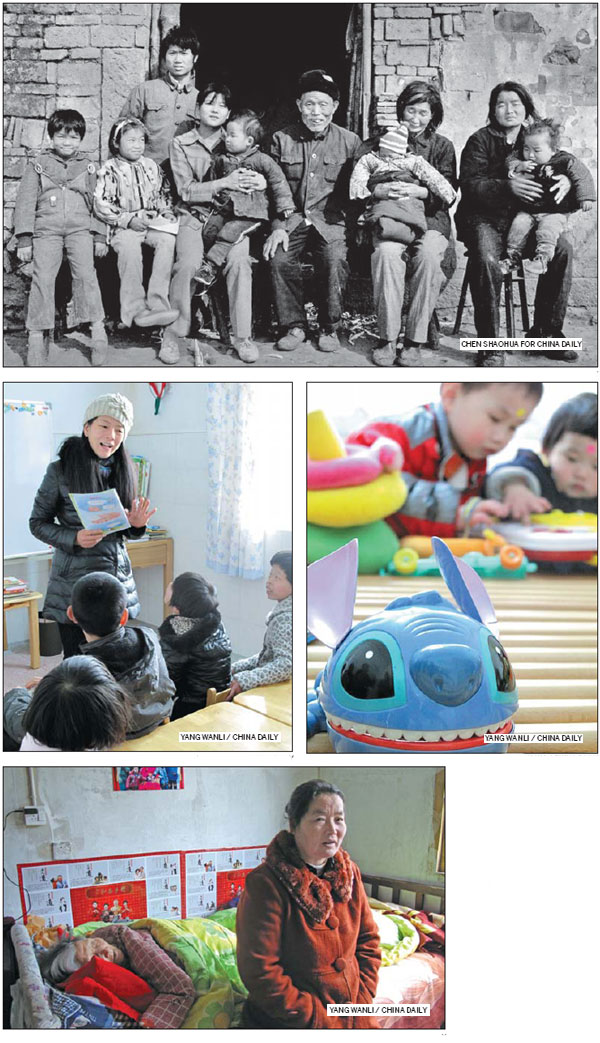
Clockwise from top: Lou Xiaoying (second right) and her husband (third right) pose for a picture with their biological and adopted children in Jinhua, Zhejiang province, in Janaury 1988. Children enjoy playtime at the First Children's Welfare Home in Jinhua. Lou Xiaoying, now 89, has uraemia and is cared for by biological daughter, Zhang Caiying. A teacher gives a lesson to orphans at the Jinhua welfare home. Yang Wanli / China Daily |