Comments
  Print
Print  Mail
Mail  Large Medium Small
 |
|
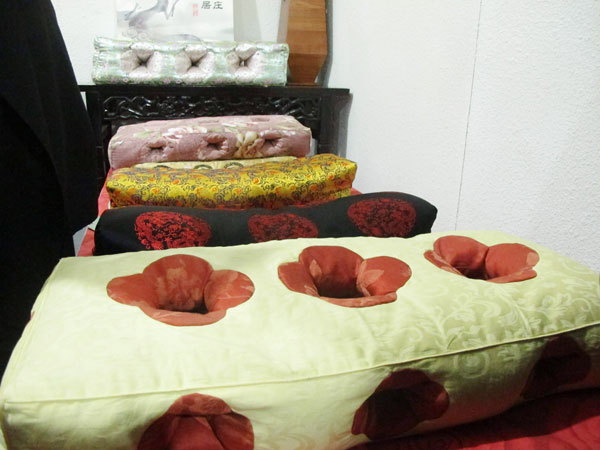
The "Xiaozhuang Pillow" has been listed as an intangible cultural heritage of Tongliao. |
Unable to find a regular job there, Mou tried a variety of temporary works, including being a street vendor and later a construction worker. "I didn't even have money to buy new clothes for my newborn child," she remembers.
|
|
|
|
|
 |
|
 |
She was pushed to pick up sewing needles for the first time in her life. But she gained skill quickly and soon her neighbors were coming to order clothes.
Although she dropped the sewing business soon after she became a successful insurance sales woman, and later opened a store selling precious stones, Mou says she has since dreamed of opening a sewing business as well.
Mou's aunt was her first teacher in making the pillows, but the elderly woman was vague on details since her skills have been neglected for years.
Mou visited museums and was referred to old craftswomen, but she found only a handful who still grasp this traditional skill. They are all in their late 80s. She keeps collecting the dying styles and gives the items a new name: "Xiaozhuang Pillows".
"The most important characteristic for noble families was their intricate detail rather than the flamboyant appearance," Mou says when picking up a spherical pillow. "For example, we have eight stitches within one centimeter of cloth here while there are only four in most regular clothes. The making of such an item is time- and material-consuming."
Mou uses 2.4 meters of cloth (75 cm in width), usually silk or artificial silk, just to make a pillowcase, and much more cloth for its interior.
She can only finish one pillow per day even after acquiring some modern cutting machines in 2012. One item will thus sell from 800 to 2,600 yuan ($125 to $420), which she confesses is too high for local market.
Mou still runs her business of selling precious stones, but she says it has declined because she has been wholly devoted to reviving this Mongolian pillow tradition. However, her pillow sales in 2012 totaled a mere 70,000 yuan, which she says hardly covers the cost.
Despite all the difficulties, she doesn't intend to make any compromises on craftsmanship.
"I don't want to compete with big textile manufacturers in those southern provinces," she says, referring to her small and crowded workshop. "I prefer to call this a prolonged history rather than a commodity."
The "Xiaozhuang Pillow" has been listed as one of the city's intangible cultural heritages, a bonus that has Mou hoping for more support from the municipal government to get more people involved.
According to Wang Xianghong, the city's deputy head of the employment management office, the municipal government has established a project to encourage the city's development of creative entrepreneurs like Mou. It offers workshops for free use and even waives their tax for three years.
Mou fears that her pillows are not qualified to earn an export license because the yield is too small, despite the fact that she has trained about 10 artisans.
"I am worried if someone throws me a big order," Mou says, noting that some luxury hotels in Hohhot, Inner Mongolia's capital, wanted to replace all of their pillows with hers. But the quantity needed was more than she could handle. "And I have to hoard some pillows in case I open an online store."
There have been many replicas on e-commerce retailer Taobao.com after she attended some exhibitions around the country, she says with a sigh. Though most of these pieces are not as delicately made as hers, she worries such mass-produced items will bury her products.
But she says she is glad that the traditional craftsmanship is attracting young enthusiasts.
Zhao Haicun, a Tongliao native who worked in a costume factory in Shenzhen, for three years, returned home due to the slumping export industry in Guangdong province. He ran an ice-cream shop until he found Mou's ambitious project and joined the pillow squad in 2011.
"I didn't know about such a beautiful Mongolian pillow before, though it is made in my hometown," says the 31-year-old.
Zhao says he enjoys his current job with the pillow workshop, since he has the basic skills thanks to his previous job. Plus, he says with a smile, he has "much more free time than in my days in big factories".
Contact the writer at wangkaihao@chinadaily.com.cn.

Copyright 1995 - 2010 . All rights reserved. The content (including but not limited to text, photo, multimedia information, etc) published in this site belongs to China Daily Information Co (CDIC). Without written authorization from CDIC, such content shall not be republished or used in any form. Note: Browsers with 1024*768 or higher resolution are suggested for this site.
License for publishing multimedia online 0108263 Registration Number: 20100000002731