Nibbling away at food waste
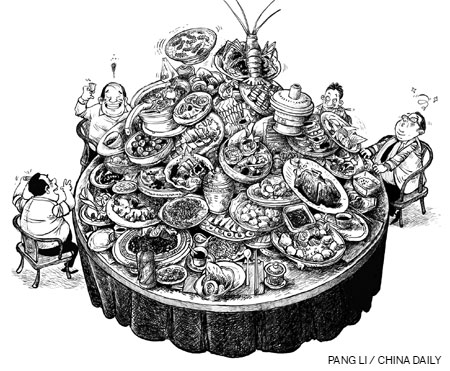
The Chinese penchant for purchasing more food than necessary, especially in restaurants, is linked to our obsession with image. It can't be easily abolished but should be chipped away a block at a time to give way to common sense.
Every Chinese student is taught this Tang Dynasty poem:
Farmers weeding at noon, sweat down the field soon. Who knows food on a tray, thanks to their toiling day.
In the Chinese original, the word "food" receives emphasis, literally meaning: "every grain on the plate is an embodiment of hard work".
Chinese parents would use this to teach their children not to waste food because it is the product of farmers' exhausting labor under the scorching sun or in rainstorms.
Yet, when they dine out, they'll be astounded by the amount of food squandered. Of course, food in the poem refers to grains, the staple in the Chinese diet as people in subsistence hardly had access to meat and other high-protein items. But, nowadays, the food that's thrown away is mostly the expensive dishes.
Take a pricy fish that was not touched at all by the restaurant customer. When the waiter was asked by a television reporter how he felt about it, he replied: "What can I do? This dish would cost me a month's salary."
By one estimate, there is so much food wasted in China that it can feed 200 million people.
The No 1 culprit, as I see it, is the face issue - the traditional Chinese notion that one should order more than necessary simply to show one's hospitality.
Make that much more.
|
|
Depending on the guests, it could be one third more to three times more than necessary. The more distinguished the guests, the more food the host will order.
If every dish is finished by the end of a meal, the host will not be complimented for being smart.
Instead, the host may receive behind-the-back sneer that he or she was being too stingy - an accusation that any conformity-minded Chinese would take pains to avoid.
On occasions such as Lunar New Year's Eve dinner, it is customary to leave portions unfinished as an auspicious sign that the coming year will bring in more abundance.
From my personal experience, the most egregious food prodigality in China comes from government and corporate expense accounts.
When these people throw a banquet, you'd better forget about that Tang poem, or you'll be squirming in agony.
My rough estimate is, the food is usually enough to feed three times the number of participants.
For example, some of the high-end feasts divide up each course, a la Western dinner, but there are usually 15-16 courses.
Compare it to a Western dinner, which has appetizer, soup or salad, main entree, cake and drink - all together five items, including the less filling appetizer and drink.