Comments
  Print
Print  Mail
Mail  Large Medium Small
 |
|
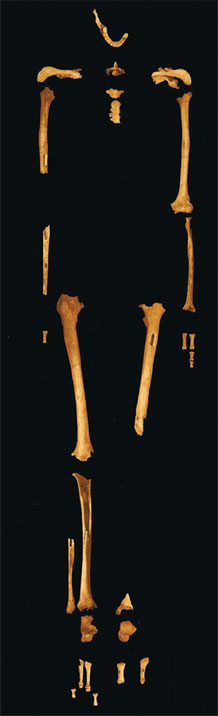
The Tianyuan skeleton was unearthed near the Zhoukoudian site, about 50 km southwest of Beijing. Photos provided to China Daily |
Gao Xing, deputy director of the IVPP, who also participated in the research, says: "This is the first time that Chinese paleoanthropologists extracted DNA from ancient humans who lived more than 10,000 years ago."
Previously, scientists examined human fossil morphologies and cultural remains on a site to conjecture about the life of the ancient humans living there.
"Traditionally, we infer by observing the fossils and tools on the site, but molecular biology has opened a new door for us," Gao explains.
"For example, based on isotope analysis of carbon, nitrogen and oxygen, we found that the Tianyuan Cave man ate freshwater fish, which we had no way to find out from studying fossil morphology, and there is no tool left in the cave for such analysis."
But buried in the cave for tens of thousands of years, most DNA contained in the bone had been destroyed. Bacterial contamination has made it even more difficult to extract the DNA.
"Only 0.3 to 0.4 percent of the DNA belonged to humans. The rest was bacteria," says Fu Qiaomei, primary author of the research paper, which was published in the Proceedings of the National Academy of Sciences of the United States of America.
"Finding the human DNA is like looking for a needle in a haystack. It needs strong technical support," Fu says.
The Max Planck Institute, as the industry leader in this field, provided technical support for the research.
As early as 2009, the Max Planck Institute and Chinese Academy of Sciences jointly built a laboratory to study the evolution of humanity.
"China has abundant research materials for paleoanthropologists, and that's a major reason that foreign institutes are attracted to China," says IVPP deputy director Gao Xing.
He says that now paleoanthropologists are quite certain about the human evolutionary pathway in Africa and Europe, but there is still a research gap in East Asia.
"East Asia and Africa are the two most promising regions for paleoanthropology research, and the jigsaw will not be completed without figuring out the situation in China," he adds.
As for the theories of the origins of modern human beings, there are two popular explanations: one is that modern humans are descendants of regional archaic-type human groups in Africa and Eurasia about 40,000 to 50,000 years ago; the other is that modern humans thrived about 200,000 years ago in Africa and later migrated elsewhere.
Gao says the latest breakthrough shows that 40,000 years ago, Asians and Native Americans were still related by blood, but their DNA had divided since the time of modern Europeans. Those discoveries are still not enough to give a full picture of human evolution.
"We won't be able to find the answer on our own. Only by gathering the information across the globe will you be able to piece the puzzle of human evolution together," Gao says.
Contact the writer at chengyingqi@chinadaily.com.cn.
|
 |
 |
 |

Copyright 1995 - 2010 . All rights reserved. The content (including but not limited to text, photo, multimedia information, etc) published in this site belongs to China Daily Information Co (CDIC). Without written authorization from CDIC, such content shall not be republished or used in any form. Note: Browsers with 1024*768 or higher resolution are suggested for this site.
License for publishing multimedia online 0108263 Registration Number: 20100000002731