Comments()
  Print
Print  Mail
Mail  Large Medium Small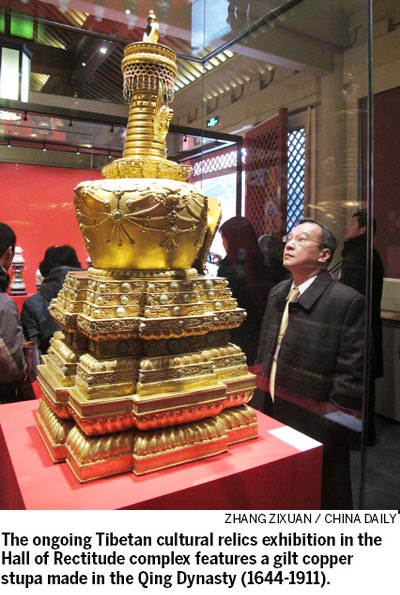
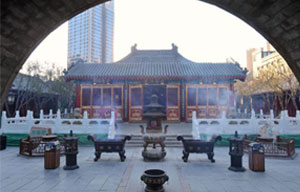
The Hall of Rectitude complex, the most concentrated Tibetan Buddhist architecture group within the Forbidden City, has been successfully restored. It was destroyed almost a century ago, during the Qing Dynasty (1644-1911).
Related: China issues special stamps for Confucius Institutes
The six-year restoration project was handled by the Palace Museum and the China Heritage Fund, a Hong Kong-based NGO that preserves and restores cultural relics throughout China.
"The restoration brought back to life an exquisite imperial ground," says Shan Jixiang, director of the Palace Museum. "The blemish from the devastation of the previous century has been removed, making the Forbidden City whole again."
Located at the northwestern part of the Forbidden City and the south of the Garden of the Palace of Established Happiness, the Hall of Rectitude complex is composed of 10 Tibetan Buddhist buildings with the Hall of Rectitude at the center.
"The complex is the only area within the Forbidden City consisting only of Buddhist architecture," says Wang Yuegong, deputy director of the Palace Department and secretary-general of the Tibetan Buddhist Heritage Research Center of the Palace Museum.
It used to serve as the site of Tibetan Buddhist rituals and the storage space for Buddhist cultural relics, such as sutras, statues and thangka. Its function had been augmented since 1697, during Emperor Kangxi's reign, when the Qing court established a specific organization within the Hall of Rectitude to take charge of all Tibetan Buddhist related activities.
Related: Living Buddha sees blessings in earthquake
In 1923, a devastating fire that started in the Garden of the Palace of Established Happiness spread to the complex and destroyed all except the Pavilion of the Rain of Flowers, a section of the Hall of Precious Prosperity and two other smaller structures.
From 2000-05, the Palace Museum and the China Heritage Fund have successfully restored the Garden of the Palace of Established Happiness. In 2006, the two organizations rebuilt the Hall of Rectitude complex based on historical documents, file photos and paintings.
"The China Heritage Fund didn't just invest the money but also considered the project as an inheritance undertaking," says Shan, director of the Palace Museum.
"The destruction of a nation's cultural heritage reflects the country's decline and turmoil. But its restoration is a sure sign of the country's rise and prosperity," echoes Ronnie C. Chan, founding chairman of the China Heritage Fund. "I would be the biggest fool in the world if I didn't do it."
The complex will recover its historic function to serve as the Palace Museum's Tibetan Buddhist Cultural Heritage Research Center and as the exhibiting space for Tibetan Buddhist cultural relics.
An exhibition featuring more than 100 relics is ongoing at the complex to celebrate its completion.
zhangzixuan@chinadaily.com.cn



Copyright 1995 - 2010 . All rights reserved. The content (including but not limited to text, photo, multimedia information, etc) published in this site belongs to China Daily Information Co (CDIC). Without written authorization from CDIC, such content shall not be republished or used in any form. Note: Browsers with 1024*768 or higher resolution are suggested for this site.
License for publishing multimedia online 0108263 Registration Number: 20100000002731