Comments()
  Print
Print  Mail
Mail  Large Medium Small
 |
|
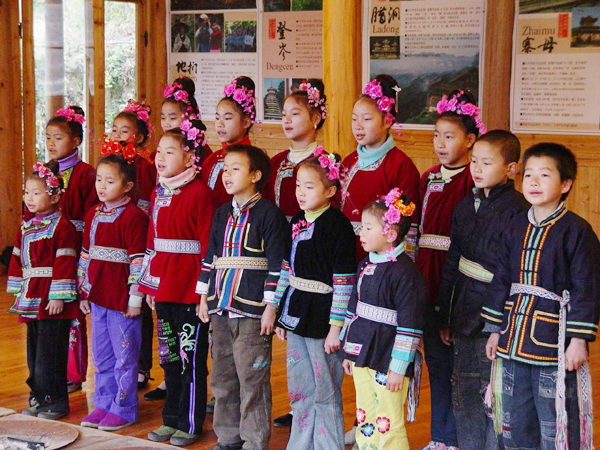
Dong students sing during a two-hour traditional singing lesson at Dimen Dong Cultural Eco-Museum, as part of the 100 Dong Songs program. Provided to China Daily |
Only youth can save the cappella tradition that has passed down the culture and history of the Dong ethnic group. Wei Wei and Cai Chunying report in Washington.
A day after she was honored at the White House and hugged by first lady Michelle Obama, 13-year-old Wu Lianyun was en route to Dimen, an enclave in the mountains of Guizhou province.
All of Dimen's residents, including Wu, are of the Dong ethnic group.
In Washington, Wu had helped represent the 100 Dong Songs program organized by the Western China Cultural Ecology Research Workshop. Along with the group's secretary, Ren Hexin, the teenager collected an International Spotlight Award at a White House ceremony on Nov 19.
The award is given by the US National Arts and Humanities Youth Program to outstanding community-based extracurricular initiatives. Among this year's dozen honorees, 100 Dong Songs was the only winner from outside the US.
As part of a broader Dong-culture effort, 100 Songs is dedicated to preserving the ethnic group's folk music. Established in 2003, the musical effort has cultivated more than 800 "young heirs" to this indigenous tradition, says Ren, also the curator of Dimen Dong Cultural Eco-Museum.
Related: Europeans explore China's musical dream
Taught by seasoned Dong singers, about 100 young people like Wu perform every Saturday morning in the Dimen cultural eco-museum.
About 100 folk songs were collected from the region and recorded on a CD with lyrics translated into Mandarin for use in the music classes of local primary and middle schools.
"Because young people are key to perpetuating these cultural traditions, the workshop plays an important role in inspiring Dong children and youth to appreciate and preserve their heritage," read the White House description of the Dimen-based program.
It was nominated for the award by the Asia Society.
Amy Tan's Dimen
Numbering more than 2.9 million and one of China's 55 acknowledged non-Han ethnic groups, the Dong had no written form of their language, Kam, until 1958. They had been passing down their culture and knowledge through songs.
Dimen, founded during the Tang Dynasty (AD 618-907), is the second-biggest Dong enclave in China and a historical source of folk songs.
Amy Tan, the Chinese-American author of The Joy Luck Club and other novels, wrote about the Dong tradition of communicating through songs in a 2008 article in National Geographic magazine.
From 2005-07, Tan visited Dimen three times to prepare for a San Francisco Opera production of The Bonesetter's Daughter, based on her 2001 novel of the same name.
"Entering into the village I had little girls singing those songs - those Dong songs, the welcoming songs - one at each elbow And they sing on key, on rhythm, perfectly a cappella in tune with one another," Tan wrote in her National Geographic essay, headlined Village on the Edge of Time.
Sadly, this heritage, recognized by the United Nations Educational, Scientific and Cultural Organization in 2009, has been fading from the Dong's daily lives for about 30 years, says Ren, who grew up in Liping county, where Dimen is located.
"Unlike Peking Opera or other Han people's art that is independent from life, Dong songs used to be part of Dong people's lives," he says.
"But the soil for this 1,000-year-old singing tradition has almost disappeared."
Related: More than gourmet: Miao Wang Restaurant
Dong songs were banned during the "cultural revolution" (1966-76), when many art and cultural forms were condemned. But even after the ban was lifted, the predominance of Mandarin made singing in their native tongue unnecessary for Dong people, Ren says.
Joanna Lee, who is active in the preservation of Dong culture through her work for the Western China Cultural Ecology Research Workshop, has seen the upside and downside of economic development in Dimen.
Ten years ago, Ren took Lee and her husband on the couple's first trip to the village.
"It wasn't until 2002 that Dimen had electricity," Lee recalls.
"But suddenly, in 2006, almost every household had a television. People's lives improved further, after the abolition of agriculture taxes in 2007. But because of television, popular culture and everything coming in, people don't value as much what is actually their own. They don't have an interest in leaning Dong songs."
The trend of urban migration has also posed severe challenges to the Dong's centuries-old traditions.
In 2008, according to Tan, about half of Dimen's 2,400 residents worked and lived elsewhere. Immersed in the modern lifestyle, most can sing no more than a few simple Dong songs.



Copyright 1995 - 2010 . All rights reserved. The content (including but not limited to text, photo, multimedia information, etc) published in this site belongs to China Daily Information Co (CDIC). Without written authorization from CDIC, such content shall not be republished or used in any form. Note: Browsers with 1024*768 or higher resolution are suggested for this site.
License for publishing multimedia online 0108263 Registration Number: 20100000002731