Putting animal welfare on the public's agenda
 |
|
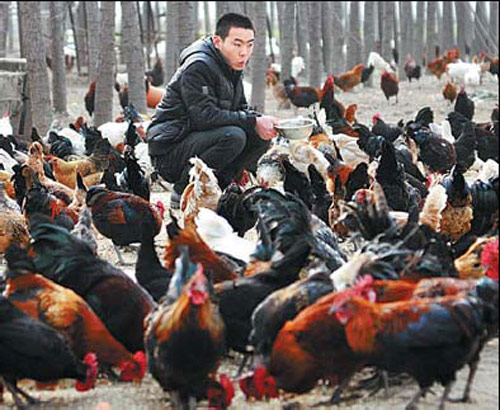
A man feeding chickens on a farm. In a society in which food safety has become Chinese people's top concern in daily life, animal welfare is closely related to people's lives and health, say animal charities and veterinary organizations. Dong Naide / For China Daily |
The World Society for the Protection of Animals, a global leader in animal welfare and the Animal Health, and Welfare Branch of the Chinese Veterinary Medical Association signed an agreement at the third China Veterinary Conference on Oct 30 on cooperation in educating people about the proper treatment of animals.
For people who don't keep pets or don't work in an environment where animals are around, they might think that animal welfare education has nothing to do with them. However, it is far more than about animals.
Animal welfare is more than providing basic care, food and water to the creatures. It also involves taking measures to satisfy both their physical and mental needs as well as protecting them from avoidable suffering caused by humans.
In a society in which food safety has become citizens' top concern in daily life, animal welfare is closely related to people's lives and health.
"If animals are suffering, in pain, or abused, this will affect their physical state as well," said Michael Appleby, chief scientific adviser to the WSPA.
"I know there are many concerns in China about food safety and, although it's not always true, but, in general, if you look after the animals better, the food is more likely to be safe."
About 75 percent of the new diseases that have affected humans over the past 10 years have been caused by pathogens originating from an animal or from products of animal origin, according to the World Health Organization.
The quality and safety of animal products such as meat, dairy and eggs is often determined by how farm animals are kept and, as well as causing suffering, poor animal welfare can lead to the spread of food-borne illnesses and infections to humans, including food poisoning, according to the WSPA.
In China, animal welfare is still in its infancy and needs to be spread among the general public because it is an idea influencing the way people live and the harmony among humans, animals and the environment.
"It has been several years since the non-governmental organizations in China first began appreciating the concept of animal welfare but, officially, the idea was introduced in the country this year, when the World Organization for Animal Health formulated animal welfare standards regarding transport, slaughter, disease control and research," said Sun Quanhui, project manager at the WSPA. He added that China has been a member country of the organization since its lawful rights were resumed in 2007.
As the world's second-largest economy, China farms and consumes a large number of livestock and poultry. Any industry technical standards introduced internationally would affect related industries in China, thus providing opportunities for promoting this "young" idea in the nation, according to officials of WSPA China.
Speaking of the mission to improve the animal welfare situation in China, WSPA Country Director, China, Li Guozhi, said: "If we want to drive social development, we need to start with education".
The WSPA has many years of experience in animal welfare education around the globe. It is used to working with governments, NGOs and schools of different levels in different countries. However, Appleby said: "One way we have found effective in many countries is to work with veterinarians because vets interact with animals and with people who have animals on a daily basis."
Under the agreement, the WSPA will help to develop animal welfare textbook material for Chinese veterinary students and practitioners as well as work with them to establish a comprehensive animal welfare education system by introducing successful international practices.
The WSPA will provide consultation, technical support and partial funding. In addition, it will also conduct in-depth research into animal welfare courses at more than 30 Chinese universities and carry out a veterinary undergraduates survey, based on which symposiums will be held to devise training for animal welfare teachers and to develop pilot education programs.
"WSPA is a global and leading international animal welfare charity organization with advanced scientific technology and rich practical experience. This cooperation agreement marks a new chapter for the promotion of animal welfare in China," said Jia Youling, president of the Chinese Veterinary Medical Association.
"It seems to me that the biggest problem in China is the visibility or invisibility of animals," Appleby said, referring to the fact that a lot of urban residents in China have never seen how farm animals are kept on farms. If they have seen how badly farm animals are treated, such as a large number of poultry being kept in quite a small space, or a high-density livestock carrier running on the highways, they would favor a system that emphasizes animal welfare, Appleby said.
huangying@chinadaily.com.cn