Comments()
  Print
Print  Mail
Mail  Large Medium Small
 |
|
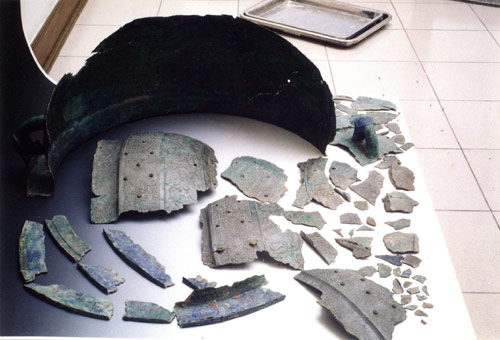
Step 1. [Photo/China Daily] |
 |
|
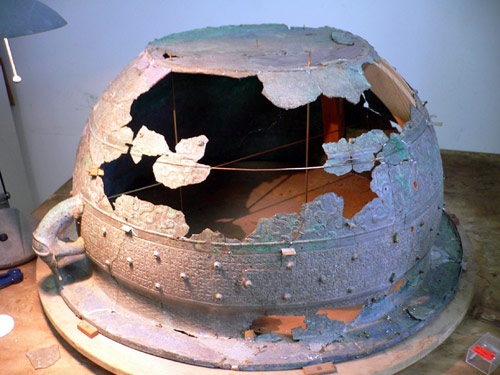
Step 2. [Photo/China Daily] |
It took a veteran antique conservator 16 years to patiently reconstruct a unique 2,000-year-old bronze bowl. Zhang Kun speaks to the man behind the tedious process.
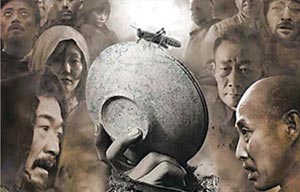
Zhang Guangmin has spent the past 16 years on a most difficult, and costly-game of jigsaw puzzles. On Oct 18, the antique restorer finally placed the last piece of the puzzle - a 2,000-year-old giant water bowl - together.
"I was very anxious to complete it this year as our museum is celebrating its 60th anniversary," says Zhang, who has been restoring bronzes at Shanghai Museum for 37 years. "Thanks to an ultra-sound knife, I have accomplished the seemingly impossible mission," he adds, in relief.
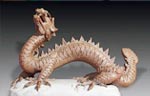
Former museum director Ma Chengyuan (1927-2004), who was also an acclaimed scholar on bronze, had purchased the bowl with intertwining dragon motifs from Hong Kong.
"Our former director bought it even though it was seriously damaged from previous restoration attempts. It is a unique piece with a highly academic and historic importance," says Zhou Ya, curator of the bronze department of Shanghai Museum.
Named "jian", the vessel is believed to have originated either from the Spring and Autumn Period (770-476 BC) or the Warring States Period (475-221 BC). Jian was used to store water, ice and bath water. After the Warring States Period, people stopped producing jian.
This one, with meticulous and complex dragon patterns, is larger than the other two vessels of the same shape among the museum's bronze collections, and the intertwining dragons make it more unusual. It measures 45 centimeters in height, 79 cm in diameter at its opening, with a base diameter of 39 cm.
Shanghai Museum has one of China's best collections of bronzes, thanks to the continuous efforts of generations of museum staff. "We have more than 7,000 pieces, forming a systematic lineage. Every piece is a national treasure and of great value," Zhou says.
He says there are no bronze sacrificial vessels in the auction market, because they cannot possibly have been inherited, and it is against the law to trade in these national treasures that belong to the State. But there has been private trading of these pieces for decades.
"Some businessmen would restore a piece by the most violent and rough means to gain a huge profit," Zhang says.
He has found altered patterns, chemical erosions, added inscriptions and other restoration efforts that had caused irreversible damage to treasured bronze pieces.
"You just have to pass by a piece - you don't even have to go up close - and you can feel the difference between a genuine treasure and an artificially crafted fake," he says. "It's as if the real thing can breathe, and emits a special aura."
The professional restorer makes sure that every work he does on a piece is reversible: The added parts can easily be removed in the future, when more advanced techniques are made available to restore the treasure more perfectly.
The restoration of the jian started with dissembling. All the added materials from the previous restoration efforts were removed. Then, the vessel is separated into innumerable small pieces.



Copyright 1995 - 2010 . All rights reserved. The content (including but not limited to text, photo, multimedia information, etc) published in this site belongs to China Daily Information Co (CDIC). Without written authorization from CDIC, such content shall not be republished or used in any form. Note: Browsers with 1024*768 or higher resolution are suggested for this site.
License for publishing multimedia online 0108263 Registration Number: 20100000002731