Comments()
  Print
Print  Mail
Mail  Large Medium Small
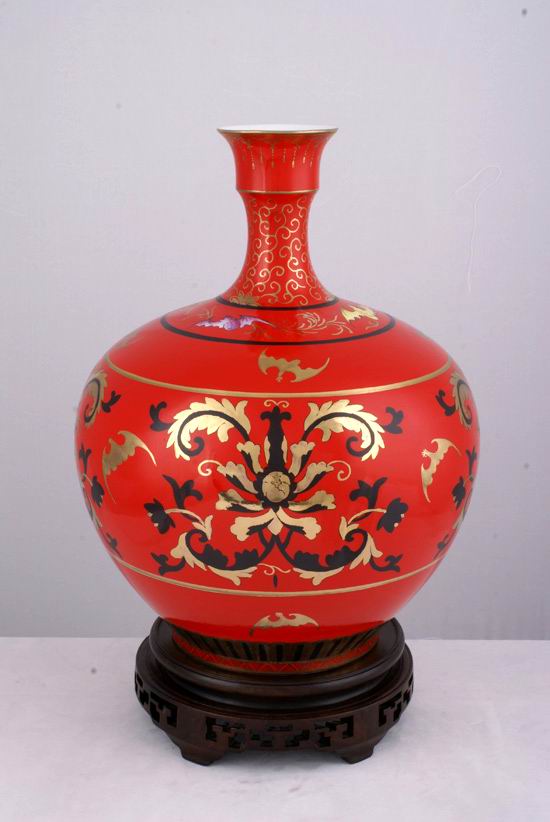
In the Yuan Dynasty (1271-1368), craftsmen began to intentionally make porcelain with red under glaze in Jingdezhen, Jiangxi Province, known as the capital of ceramics. In the Yongle Reign of the Ming Dynasty (1368-1644), the craftsmanship was very much improved, and the red color became more brilliant.
Later, Jihong porcelain began to be produced for sacrificial ceremonies. Ji means to sacrifice and hong means red. Jihong porcelain produced in Jingdezhen surpassed previous porcelain both in luster and in color. Precious gems like coral, agate, jade, pearls, and gold were sometimes added.
 |
|
The legend of Jihong porcelain |
It was extremely hard to produce this kind of porcelain, and the success rate was quite low. The successful production of red porcelain demonstrates the intelligence and dedication of the Jingdezhen people.
A popular local legend says even their blood was sacrificed for their craft. According to the story, Emperor Xuanzong in the Ming Dynasty (1368-1644) wanted to use red porcelain to worship the sun god, and issued an imperial decree ordering the Jingdezhen kiln to produce it. After many attempts, the craftsmen failed to produce satisfactory porcelain and were whipped, thrown into prison, and threatened with death if they didn't produce what the emperor desired.
Cuilan, daughter of an elderly kiln worker, was very upset when her father was jailed. Enraged at the atrocity, she jumped into the fiery kiln. Two days later, when workers opened the kiln, they were surprised to find the porcelain inside was blood red.
People thought Cuilan's blood dyed the porcelain red and this is how the porcelain came to be called Jihong.
Successive emperors also demanded expensive Jihong porcelain, but as the legend suggests, it was very hard to produce. Among the ten thousand plus items in Jingdezhen Ceramics Museum, there are only ten Jihong porcelain objects, one of which is only half of its original size and there are less than one hundred Jihong porcelain objects in museums worldwide.
Generations of Jingdezhen people endeavored to produce the porcelain in the following hundreds of years, but Jihong porcelain was never successfully reproduced. From the Ming Dynasty when Jihong porcelain was first produced, generations of Jingdezhen porcelain craftsmen have made numerous attempts to manufacture Jihong, but the results have not been as good.
The imperial kiln's only customer was the court, and it had very high product quality standards. The porcelain made in these kilns underwent a strict selection process. Works which didn't make the grade, were broken and buried because common people were forbidden to use them.



Copyright 1995 - 2010 . All rights reserved. The content (including but not limited to text, photo, multimedia information, etc) published in this site belongs to China Daily Information Co (CDIC). Without written authorization from CDIC, such content shall not be republished or used in any form. Note: Browsers with 1024*768 or higher resolution are suggested for this site.
License for publishing multimedia online 0108263 Registration Number: 20100000002731