Comments()
  Print
Print  Mail
Mail  Large Medium Small

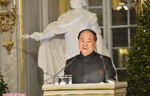
Zhang Xianliang was born in Nanjing, Jiangsu province, in 1936. At the age of 19, he moved to the Ningxia Hui autonomous region and began to write. In 1957, he was sentenced to 20 years in a labor camp after publishing a poem critical of the authorities.
After his release in 1979, he began to write novels depicting life in the harsh environment of Northwest China and his experiences in the labor camp.
His work, including Half of Man is Woman and Grass Soup, has been translated into more than 30 languages, and Zhang has become one of the most important writers in modern China. He currently lives in Yinchuan, the capital of Ningxia.
China Daily: Why is literature so popular in Ningxia, especially in the poverty-stricken, mountainous southern region?
Zhang: Actually, I'm surprised that so many people are interested in writing, despite their relatively poor standard of living. I think there is a good tradition of learning and reading in the area that the local people have tried very hard to maintain. I'm happy to see so many accomplished writers come from the area. Some of them win national and even international awards, and some work for schools, the government and publishing houses.
They set a good example for those people who want to live a decent life. They also encourage others to write. Xihaigu doesn't have many resources or opportunities, so writing has become a practical way to alleviate poverty. Ironically, literature is probably the least practical thing in many other areas.
Do you have any advice for grassroots writers in Xihaigu?
They enjoy certain advantages. They live in a quiet environment with few distractions, and they write about their lives. Nothing is more powerful than real emotions and stories.
But sometimes this can also be a weakness. Their topics are limited to village life. This problem is a common one for writers, but I hope they open their eyes, see the world outside and make a connection between themselves and their stories and the bigger picture.
I am sorry to hear that some of them have to deal with misunderstanding and even disdain. In the old days, writers, or intellectuals, were respected in the rural areas. But now things have changed, people who make the most money are most accepted.
In China's rural areas, communities are small and close. It is hard to ignore what people think about you. But if you are really into writing, you have to hold on to that.
Moreover, I hope those writers be patient. I have seen a lot of people write piles of stories but didn't manage to publish a single one. You have to face the fact that you might never be successful.
There have been suggestions that literature has become less popular. What are your thoughts on this?
Literature has never been at the center of Chinese society, except in the 1980s when I published some of my early work. At that time, people didn't have much to do, except read. That's why a writer and his work could change government policy and even people's mind.
But economic expansion means that people now have televisions, mobile phones and the Internet. It is normal for writers to feel a little disappointed as their influence declines. But if you still want to write, then stop complaining and try to write some good stories.
Mo Yan recently won the Nobel Prize for Literature. Do you have any comment?
First I want to congratulate him on winning the prize. This is a historic moment for Chinese literature. It shows that Chinese literature is becoming increasingly international.
Also, I think it is an important moment for the Nobel Prize. As an international award, it finally has a winner from the Chinese mainland. To some extent, Mo Yan completes the prize.
And I believe that China's increasing global influence played an important role in the award. Now the world is paying attention to our country.
- Peng Yining



Copyright 1995 - 2010 . All rights reserved. The content (including but not limited to text, photo, multimedia information, etc) published in this site belongs to China Daily Information Co (CDIC). Without written authorization from CDIC, such content shall not be republished or used in any form. Note: Browsers with 1024*768 or higher resolution are suggested for this site.
License for publishing multimedia online 0108263 Registration Number: 20100000002731