Comments()
  Print
Print  Mail
Mail  Large Medium Small
 |
|
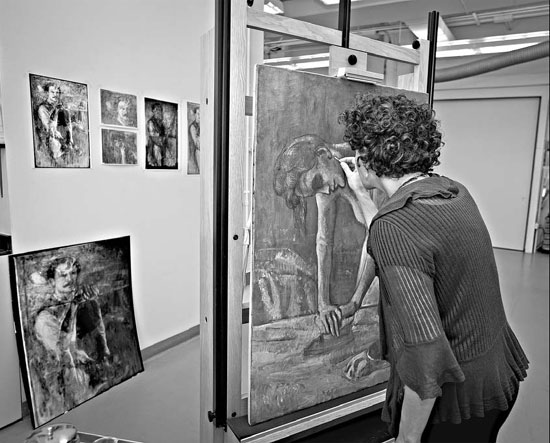
Infrared images of Picasso's "Woman Ironing" were made after the Guggen-heim conservator Julie Barten cleaned it. Experts disagree on the identity of the mustachioed man, below right, hidden beneath "Woman Ironing". Photographs by Angel Franco / The New York Times |
Picasso was just 22 through most of 1904, the year he is thought to have painted "Woman Ironing". Money was tight for him. He would often start a painting, abandon it and begin another using the same canvas.
For years conservators and art historians have known that hidden beneath the surface of "Woman Ironing," long considered an example of his Blue Period, is the upside-down ghost of another painting - a three-quarter-length portrait of a man with a mustache that was first seen in images taken with an infrared camera in 1989. But one question - who the man was - has remained unanswered.
Initially some experts thought the image might be a portrait of Benet Soler, a Barcelona tailor and friend of Picasso's who helped support him during those lean years.
"Woman Ironing" was given to the Guggenheim Museum in New York by the German dealer and collector Justin K. Thannhauser in 1978.
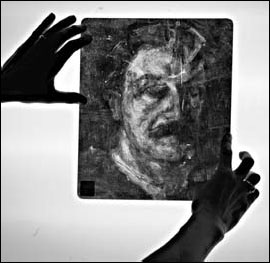
To get a clearer picture of the figure beneath the "Woman Ironing," Guggenheim conservators recently called in John K. Delaney, senior imaging scientist at the National Gallery of Art in Washington. Using two types of infrared cameras, Dr. Delaney was able to produce images far more detailed than any that had been seen before.
For the first time the shape of the man's eyes and the upturn of his mustache were visible, as were the part in his hair and a red cravat around his neck.
"You could see details like the way his sleeves are not rolled up, but buttoned," Dr. Delaney said. This new technology also revealed that Picasso had struggled with placement of one of the man's eyes, trying to render it in two different positions.
Carol Stringari, deputy director of the Solomon R. Guggenheim Foundation, said: "He is standing before what looks like either an easel or a pedestal for a sculpture, but I think it's more likely to be an easel."
The angle of the man's body as well as his piercing eyes made some people think the image could be the beginning of a self-portrait.
But that theory was dismissed because Picasso didn't have a mustache at the time, nor did the man look much like him.
So Ms. Stringari consulted several scholars, including John Richardson, Picasso's biographer. But with each clue came more theories. Mr. Richardson, relying on instinct rather than technology, studied drawings, paintings and photographs of all the likely subjects. He methodically ruled out all but one: Mateu Fernandez de Soto, a sculptor and brother of Angel Fernandez de Soto, a dandy whose portrait Picasso painted in 1903. Both men were friends of the artist's.
Picasso also painted Mateu on occasion, and shared apartments and studios with him in Barcelona and Paris. "The style of the portrait and the color palette suggests the man was painted earlier than 1904-5 and most likely around 1901," Mr. Richardson said, referring to Picasso's colorful style around 1900, when he went to Paris. "There is a tenderness and an intimacy" to the portrait, he said, adding, "You really feel this man is an artist and someone Picasso knew well."
But Ms. Stringari and Julie Barten, the museum's senior conservator, disagree. "We think it looks more like Ricard Canals, another artist," Ms. Stringari said.
Mr. Richardson argues that even though the man may look similar to Canals, it's not likely Picasso would have painted him around 1901. For one thing, "Canals was on the make," he said. "He regarded himself as Picasso's rival."
Another detail that makes Mr. Richardson think it is not Canals: the part in his hair, which is not on the same side as the part depicted in drawings, photographs and paintings of Canals.
"But even Picasso's own part changed all the time," Ms. Stringari argued.
"I'm not saying it's not possible that it's de Soto, but I don't see it," she added. "As much research as we do, we still come up with more and more questions, and those questions may never be answered."
The New York Times



Copyright 1995 - 2010 . All rights reserved. The content (including but not limited to text, photo, multimedia information, etc) published in this site belongs to China Daily Information Co (CDIC). Without written authorization from CDIC, such content shall not be republished or used in any form. Note: Browsers with 1024*768 or higher resolution are suggested for this site.
License for publishing multimedia online 0108263 Registration Number: 20100000002731