Making it right in China and Sudan
 |
|
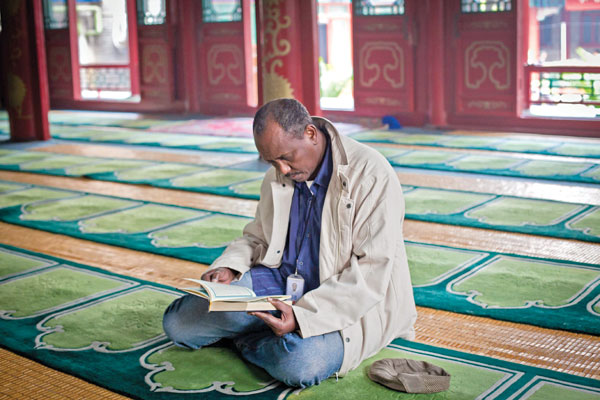
Yahya Mustafa visits a mosque in Beijing. Provided to China Daily |
When Sudanese journalist Yahya Mustafa first arrived in Beijing, he was unfamiliar with the huge city and uncertain about his future.
It has since been 18 years and counting.
The 55-year-old devout Muslim has witnessed and experienced every kind of change in China, including the rapidly growing economy, skyrocketing housing prices and progresses in human rights and media.
"Every time my family visits Beijing, they are amazed by the changes," says Mustafa. "For instance, the first time I arrived in Beijing, there were only two subway lines. Now, the subway system is one of the best in the world," says the native from Khartoum, capital of Sudan.
In 2011, Mustafa was bestowed the Friendship Award, China's highest award for "foreign experts who have made outstanding contributions to the country's economic and social progress".
"For me, it is definitely a great honor," says the Sudan News Agency journalist, who has contributed to introducing China to the Arabic-speaking world.
On Feb 2, 1959, Sudan became the second country in Africa after Egypt to establish diplomatic relations with China. Mustafa recalls seeing the arrival of Chinese people in Africa in the 1970s. He says the Chinese brought agricultural technologies and contributed to the infrastructure and medical fields.
"The Chinese people and companies did a great job in helping locals build small projects like textile factories, roads, bridges and wells, which successfully improved the industry and agriculture output," Mustafa says.
It was then that he made his first Chinese friends - journalists from Xinhua News Agency who came to his office to collect news materials.
He used to work late and would hitch a ride with the Chinese journalists back home. His house was a 10-minute walk from Xinhua News Agency's office in Khartoum.
It was through his friendship with one of the journalists, Wang Yadong, that he found out about a job vacancy at the China Radio International, got the job and flew to China.
"It meant both opportunity and challenges. After listening to stories from Wang (about China) and with my wife's support, I decided to take this adventure," says Mustafa.
"For me, the most important convenience was that I could worship in mosques in Beijing."
As a veteran political reporter, he covered China's top political events, including the two sessions of the National People's Congress and Chinese People's Political Consultative Conference.
One of his most impactful reports was about a successful entrepreneur in the Ningxia Hui autonomous region, a western province with a high population of Chinese Muslims.
The Arabic report headlined "From a jobless factory worker to an entrepreneur", which Mustafa wrote in 1999, described the entrepreneur as a success story resulting from China's reforms and opening-up policies. The story was later cited in many Islamic media. In 2003, Mustafa received the annual outstanding award from CRI.
He has been working for China.com, a national multilingual website in Beijing, since 2006 and has been named as an outstanding employee for five years.
"Mustafa is a very professional and responsible newsman. He helped us a lot on Arabic writing and taught us how to be real journalists," says Zhang Qiongying, Mustafa's colleague.
Mustafa says the media landscape in China has changed since he first started working in Beijing.
"In the early 1990s, few Chinese government sectors had news conferences. Now, most government departments have regular news conferences to release news to domestic and foreign media," says Mustafa.
"Of course, China has its own problems, like every country in the world. But some Western media have a strong bias when reporting on China. They ignore the amazing progress.
"To balance the voice, Chinese media need to be more professional, more open and transparent, more active to report domestic and foreign news from different angles."
In recent years, Mustafa has seen negative news, all from the Western media, about the relationship between China and African countries. They include Darfur, anxiety about the so-called Chinese expansion in Africa and the poor quality of Chinese products.
"In Sudan, anytime, if you ask local people if they dislike Chinese people, they will laugh at you," says Mustafa.
"Despite the long-term and stable friendly relationship between China and us, business is still business. The African countries chose China simply because China has better things to offer and, most importantly, without other affiliated pressure on politics.
"Some Chinese products do have quality problems. But you can't simply blame all Chinese producers. The truth is, sometimes, local importers in African countries who want to make more money purchase cheap goods from China. If you want good quality, you have to pay more," he says.
Mustafa plans to return to Sudan after he retires. "When I go back to Sudan, I will introduce the real China to my fellow people," he says.
wangru@chinadaily.com.cn