Comments()
  Print
Print  Mail
Mail  Large Medium Small
???
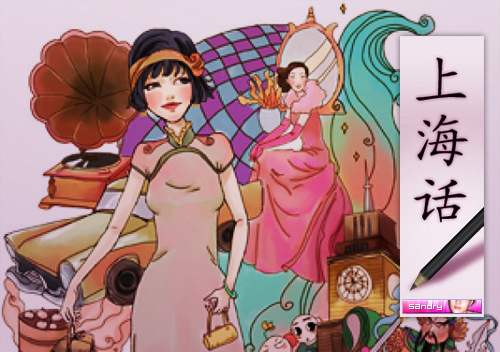
Shanghai dialect is a dialect spoken in the city of Shanghai and the surrounding region.
Shanghainese, like other Wu dialects, is largely not mutually intelligible with other Chinese dialects such as Standard Mandarin. The term "Shanghainese" in English sometimes refers to all Wu Chinese dialects. It is only partially intelligible with other subbranches of the Wu language group.
Shanghainese is a representative dialect of Northern Wu; it contains vocabulary and expressions from the entire Northern Wu area (southern Jiangsu, northern Zhejiang). With nearly 14 million speakers, Shanghainese is also the largest single coherent form of Wu Chinese. It once served as the regional lingua franca of the entire Yangtze River Delta region.
Shanghai dialect has very different pronunciation from Mandarin and Cantonese, including several sounds that are not found in any other Chinese dialect. Although the bulk of vocabulary is the same, there is also considerable variation in words and phrases.
As people have become more appreciative of its unique value – and perhaps more sensitive to conservation issues generally – Shanghai dialect has undergone something of a revival. Public lessons are now conducted in some kindergartens and language organizations, while several TV programs (such as ‘old uncle’, a farce opera series in local style and dialect) have regained popularity, alongside dialect classics such as The House of 72 Tenants (Qishi er jiafangke) and Muddle-Headed Parents
Some slight taste of the dialect might be gleaned from the following examples:
-- In Shanghainese, you don't ‘drink’ beverages or ‘smoke’ cigarettes, you ‘eat’ (chi) them both! -- An effeminate man can be described as having ‘a(chǎn) woman’s voice’ (niang niang qiang). -- The Mandarin expression ‘bu san bu si’ (‘neither three nor four’, meaning ‘dubious’) becomes ‘bu er bu san’ (‘neither two nor three’) in Shanghai dialect. -- In Mandarin, one ‘shou bu liao’ (‘can't stand’) something intolerable, but in Shanghai dialect, one ‘chi bu xiao’ (‘can't digest’) it. -- In Shanghainese, a thief is described as ‘zei gu tou’ (‘bad to the bone’). -- The Shanghainese expression ‘qing ni chi sheng huo’, literally meaning ‘giving you the treat of your life’, is actually a threat to beat you senseless. -- To be ‘lin bu qing’ in Shanghai dialect is to be clueless and stubborn. -- In Shanghai dialect, you never ‘wash’ your face, hair or anything else, instead you ‘beat’ (da) them.



Copyright 1995 - 2010 . All rights reserved. The content (including but not limited to text, photo, multimedia information, etc) published in this site belongs to China Daily Information Co (CDIC). Without written authorization from CDIC, such content shall not be republished or used in any form. Note: Browsers with 1024*768 or higher resolution are suggested for this site.
License for publishing multimedia online 0108263 Registration Number: 20100000002731