Cast aside
 |
|
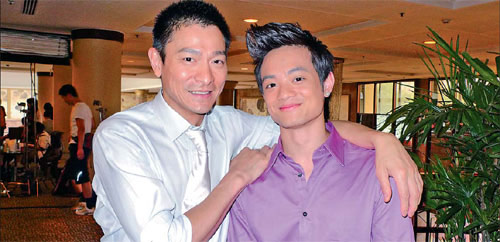
Asian superstar Andy Lau and Osric Chau. Photos Provided to China Daily |
Increasingly Asian actors from North America are finding that China provides the opportunities that are lacking in Hollywood. Liu Wei reports in Beijing.
Osric Chau, 26, found himself on the set of his first Chinese film, a remake of the 2000 Hollywood hit What Women Want, on a spring day of 2010. Having portrayed a Tibetan monk in Roland Emmerich's disaster epic 2012, the Vancouver-born Chinese got the role to work with Asian superstar Andy Lau soon after he arrived in Beijing.
He thought he recognized Lau standing not far from him and went up to him, to get to know him and practice his Chinese. He struggled in Chinese for 15 minutes and eventually discovered the man was Lau's photo double.
"We talked about regular things, like nice to meet you, how is the film, just about everything except his name," Chau recalls, laughing. "For a while I did wonder how he could look so young and then I told myself it was because he was Andy Lau and he keeps in good shape."
While China is where Chau's ancestors come from, it was still full of surprises.
"One thing that I love about working in China is the possibilities," he says.
Chau worked as a post-production coordinator, while acting as Lau's assistant. With his bilingual ability he helped visual, sound and editing employees communicate with the director.
"It would never happen in Hollywood. They would have had someone for the position and would not let a person with no experience do it," he says.
The 29-year-old actor Alfred Hsing has some anecdotes to share, too. The winner at the 2009 World Wushu Championships, like Chau, he is a young Chinese actor who grew up in North America, had some Hollywood experience, but is now part of China's entertainment industry.
A graduate of UCLA's economics department, Hsing often asked for leave or ended his meetings early when working at an accounting firm, in order to act in films or television shows, or compete in martial arts contests. Two years later, he decided to become a professional actor.
He had auditions and offers and won over his parents' support, but with an Asian face, he had to confront more challenges than Western actors.
According to talent manager and producer Lillian Ng, who has rich experience working in both China and the US, Asian-American actors are typically typecast in Hollywood.
Male actors typically audition for the Chinese restaurant storeowner, kung fu master, or comedic Asian character. Classic examples are Ken Jeong, Jackie Chan, and Jet Li. The female roles are mostly sex symbols, such as Lucy Liu and Maggie Q - though Sandra Oh has been offered breakout roles.
"Although we are seeing more and more Asian (both native Asian and Asian-Americans) faces on the big screen, the opportunities for Asian actors are getting slimmer," she says. "Producers are inclined more to give the roles to well-known actors. Given the shrinkage of Hollywood productions, there are only so many Asian roles on offer, and most of the Asian actors are competing for the same role."
In 2010, through a friend, Hsing knew Jet Li was looking for an assistant. He sent his resume and got the job after an interview.
In Beijing, he had a role in The Sorcerer and the White Snake, co-starring Li, then in Feng Xiaogang's disaster epic 1942. Now he is shooting a romantic comedy starring Zhang Ziyi.
Like Chau, he is impressed by the flexibility of Chinese sets.
"In America, it is all about the actors' union and conditions," he says. "There should be food, lunch breaks and extra pay when you work overtime, but in China you finish the work only when the decision maker on the set says it is time."
The bright side is, while he is a supporting actor in the Zhang Ziyi film, he can also work on the production team and learn about what goes on behind the scenes.
"The Chinese film industry is still building a sophisticated system, so there will be chaos, but at the same time there are unconventional ways of getting things done, creativity and opportunities," says Ben Erwei Ji, managing director of RG Communications and a senior producer who has worked at both major Hollywood and Chinese studios.