Sports director leaves strong legacy
Obituary
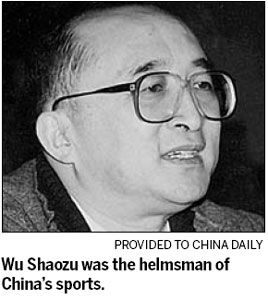
Wu Shaozu, former director of General Administration of Sports of China, passed away at age 73 on Sept 18, in Beijing.
"He was the helmsman of China's sports," comments Chen Peide, former director of Zhejiang Provincial Sports Bureau.
Born in 1939, in Xi'an, Shaanxi province, Wu came from a revolutionary family, whose parents were both Party pioneers.
In 1964, Wu got his bachelor's degree on theoretical nuclear physics from Tsinghua University.
After 1965, he had several positions in China's core organizations, such as the State Council and the Commission of Science, Technology and Industry for National Defense.
However, Wu has been best remembered for his contributions to China's sports.
After being conferred the title Major General in 1988, Wu was appointed as the fifth and last director of State Physical Culture and Sports Commission. In 1998, Wu became the first director of State General Administration of Sports, after the State Council conducted institutional reform.
During Wu's term of office, he participated in Beijing's first bid for the Olympics. He led the Chinese sports delegation to participate in the 25th Barcelona Olympics in 1992 and the 26th Atlanta Olympics in 1996. China ranked fourth in terms of its gold medal tally at both two Olympics.
Wu also earned a reputation for anti-doping.
At the Hiroshima Asian Games in 1994, Chinese athletes were checked for having forbidden drugs by the World Anti-Doping Agency. This incident made Wu realize the severe damage drugs were causing to China's sports circles.
Wu promoted a series of regulations to prohibit drug use.
"We get the gold medals, as many as we can. But we only get them right and we don't cheat," commented Wu at an international Olympic forum.
He was invited by the International Olympic Committee to share his positive experiences. The former IOC president Juan Antonio Samaranch praised Wu as the "model of anti-doping".
Wu was also the first person to suggest Chinese soccer was professionalized. There used to be just 1,000 professional soccer players in China. By the time Wu was transferred from the sports system in 2000, there were more than 300 football clubs and 60,000 professional soccer players nationwide.
Li Zhigang, reporter of Qilu Evening News in Shandong province, has interviewed Wu several times throughout the years. Wu's image as a friendly and senior figure is still vivid in Li's head, so are the countless books crammed in Wu's home.
"Wu stressed that we should consider the Olympic strategy from a historical, developing and dialectical point of view," Li recalls.
"He also told me about the Olympic spirit, which meant more than the Olympic Games and gold medals."
zhangzixuan@chinadaily.com.cn