Comments()
  Print
Print  Mail
Mail  Large Medium Small
 |
|
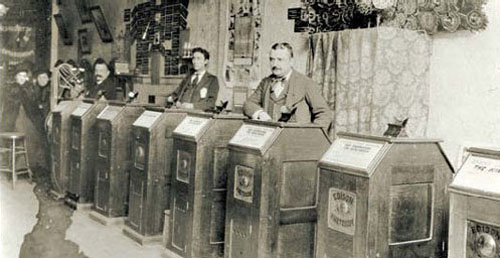
Before big screens made cinema a social and sensual event, movies were viewed through tiny holes in Kinetoscopes. National Park Service |
Early in the history of the Big Screen, back to the 1890s, you'll find no screen at all.
The earliest motion-picture viewing was a solitary experience. One looked through a peephole in a Kinetoscope, a waist-high cabinet in which a light illuminated the frames of a continuous film loop. A magnifying lens was attached to the peephole, but the images remained tiny.
When projection arrived, movie images could be made larger than life, on a big screen accompanied by big sound. Taking in a movie became not just an immersive experience, but also a social one, with audience members sitting in the dark together, laughing and crying.
Today, movie watching is, again, solitary, involving small images on a laptop, a tablet and, tinier still, a cellphone. The convenience comes at a price: the immersive cinematic experience has been lost.
The newest titles are available through Apple or Google for inexpensive rental on the small screen. (Apple made movie rentals available for phones in 2008, and Netflix, the leader in streaming older movie titles, introduced a smartphone app in 2010). Cellphone owners can rent "Hugo," the 2012 Academy Award winner for cinematography, for $3.99 and watch it on a screen whose size is not much larger than the image seen through the Kinetoscope's peephole.
When an online movie is viewed at home on a giant flat screen and heard through an expensive sound system, the sensory experience surely exceeds what might be had at a rundown multiplex. But movies viewed on mobile devices aren't going to give the brain's sensorium much stimulation.
"It's a sensual experience when you go to a theater, if there's sharp projection and six-track sound," says John Belton, a professor of English and film at Rutgers University in New Jersey. "That is a very different experience than watching on an iPad."
In an early movie palace that might hold 5,000 people, a screen might have been only 4.5 meters wide. But the images became larger around the time that sound arrived in the 1930s.
Then, in the 1950s, as Hollywood found itself competing with television, it used special lenses to create movies for screens of expanded width, as wide as 19.5 meters. This was, Professor Belton says, part of Hollywood's campaign "to show the limitations of television." Later, Hollywood reversed course and began selling to TV, though that meant cropping its pictures so they would fit on a small screen.
The most glorious attempt to fully engage the theater spectator's senses was Cinerama, introduced in 1952. Filmed with three cameras outfitted with wide-angle lenses, it used three wide screens, put together in a sumptuous near-semicircle of 146 degrees.
"This gives you a 'first-person' experience," says Thomas Hauerslev, editor of the Web site In70mm. "You see what you'd see if you were sitting where the camera is." He says IMAX "is not a first-person experience - it's just big."
Each frame in Cinerama is 50 percent taller than a regular frame, providing more detail. This makes the cinematic illusion "extremely realistic," Mr. Hauerslev says.
Cinerama was costly, and its commercial life was short. It was used only for travelogues, except in 1962, when "How the West Was Won" and "The Wonderful World of the Brothers Grimm" were released.
The Cinerama name was transferred to a smaller format, and then it, too, was abandoned.
Cinerama was the high point in sensory immersion; yesterday's Kinetoscopes and today's smartphone screens, the low points.
"If you look at the great Hollywood classics in the 1930s and 1940s, you'll see many wide master shots and sparing use of close-ups," says John Bailey, a cinematographer. "But with the advent of TV and now also with smaller screens, we're seeing more close-ups."
Movie producers will probably keep adapting, changing movies themselves so that they look better on a tiny screen.
"You can say it's 'watching a movie,'" says Professor Belton of viewing on mobile devices. "But it's not cinema."
The New York Times



Copyright 1995 - 2010 . All rights reserved. The content (including but not limited to text, photo, multimedia information, etc) published in this site belongs to China Daily Information Co (CDIC). Without written authorization from CDIC, such content shall not be republished or used in any form. Note: Browsers with 1024*768 or higher resolution are suggested for this site.
License for publishing multimedia online 0108263 Registration Number: 20100000002731