Comments()
  Print
Print  Mail
Mail  Large Medium Small
The words for fish and abundance are pronounced the same in Chinese (魚(yú),yu) so the fish in the Chinese culture symbolizes wealth. Fish also symbolize harmony, marital happiness and reproduction because they multiply rapidly and sometimes swim in pairs. Chinese legend says people placed messages in the bellies of the fish, and thus the fish has come to symbolize communication with a distant friend or loved one. Fish is an important symbol in the Buddhist religion and are among the auspicious signs on the Footprints of Buddha. The fish on the Buddha footprints signifies freedom from all restraints. The most popular fish motif found in Chinese art and culture is that of the Carp or Koi fish. Known to most Westerners as Koi Fish, the Chinese carp has numerous symbolic values within Chinese culture. The carp is a powerful symbol of strength and perseverance. The scales and whiskers of the carp resemble that of a dragon, a great symbol of power in China. At the New Year Festival "lucky money" is given out in red envelopes decorated with a carp and symbols of long life such as peach and pine trees. The word "koi" comes from the Japanese word meaning "carp". Koi fish have many different colors with the major colors being black, white, red, yellow, and cream colored.
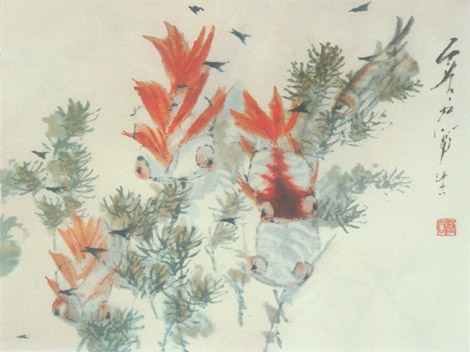
In this painting, four goldfish sink to the bottom among green algai in the clear water. Two fish have their backs toward the vewer and the other two have their underside shown. Although the agility of real life goldfish is absent and the artist disregards the customary taboo against showing the underside of fish in paintings, the simple, na?ve charm of the goldfish stands out.?
 |
|
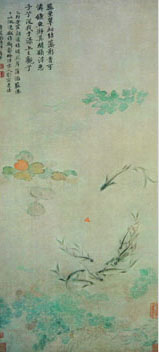
Fallen Flowers and Swimming Fish |
"You are not fish, how would you know the happiness of fish?" Chuang Tsu (369-286 BC) uttered this famous saying when he discussed an issue with Hui Tsu. The moral of the story is that others have their own enjoyment that others cannot appreciate. Yun Shouping liked to paint aquatic lives on this theme. In this work, fallen peach flowers attract a school of fish chasing after them. The fish are beautiful, free and relaxed. Duckweeds and algae are half-visible, providing enough space for the activities of fish. The application of "boneless" techniques makes the swimming fish more real and convincing. The technique of painting flowers and birds from life was already quite sophisticated in the two Song periods and it became further developed in the hands of Yun Shouping.



Copyright 1995 - 2010 . All rights reserved. The content (including but not limited to text, photo, multimedia information, etc) published in this site belongs to China Daily Information Co (CDIC). Without written authorization from CDIC, such content shall not be republished or used in any form. Note: Browsers with 1024*768 or higher resolution are suggested for this site.
License for publishing multimedia online 0108263 Registration Number: 20100000002731