Comments()
  Print
Print  Mail
Mail  Large Medium Small
 |
|
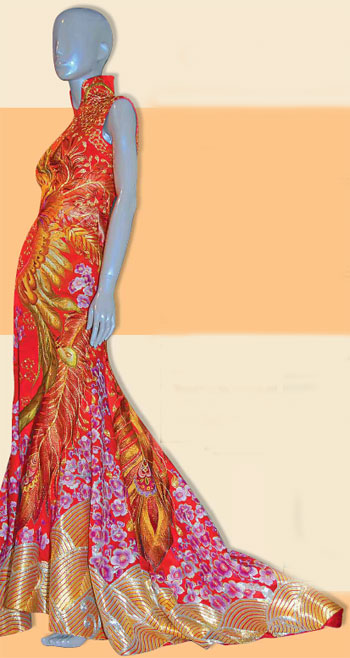
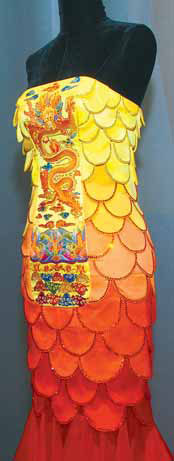
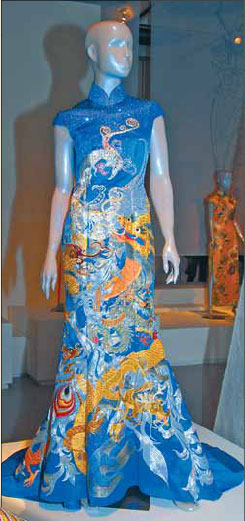
Modern qipao usually have traditional auspicious Chinese symbols. Geng Feifei / China Daily |
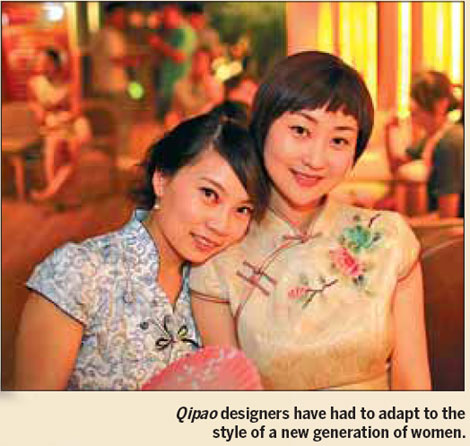
Can a traditional dress adapt to modern tastes? You bet, today's style-makers tell Tiffany Tan.
In its ninth decade, the qipao is getting a big makeover. Instead of its characteristic mandarin collar, the dress is coming out in U-, V-shaped, square, scalloped and sweetheart necklines.
Sometimes its ubiquitous skirt slit is nowhere to be found, and its customary front overlap and loop frog buttons do not actually come undone.
In some evening-gown versions, the sleeves are transformed into layers of ruffles, the back is totally bare or it gets a mermaid skirt with a train.
"The qipao of today can be modified according to the wearer's age and the occasion," Guo Pei, regarded as China's top haute couture designer, says, referring to the dress using its Chinese name.
For film celebrity Zhang Ziyi's appearance in Olympia, Greece, at the start of the torch relay for the 2008 Beijing Olympics, Guo created a white, halter-neck qipao. The contemporary cut of the neckline and sleeves were offset by embroidery featuring auspicious Chinese symbols: a dragon on the bodice and a crane against white clouds on the skirt.
"If you limit your understanding of the qipao to some small elements or details, it says you don't truly understand this Chinese dress," Guo says in a phone interview. "But the qipao still has special elements that distinguish it from Western dress, such as its simple style and body-hugging fit."
The reincarnations of the early 20th century dress - a fusion of Qing Dynasty (1644-1911) fashion and Western tailoring - does not always appear simple. Designers have had to adapt to the tastes of more sophisticated, globalized Chinese consumers, as well as a new generation of young women.
"Younger consumers would go for an edgy twist to the qipao in order not to be associated with their mom's style," says Antoine Neufmars, a Shanghai-based French stylist, who works with Chinese fashion and lifestyle magazines.
Foreigners, on the other hand, says Neufmars, prefer the dress' traditional look. The same goes for their choice in materials: They like fabrics such as silk brocade printed with the Chinese people's favorite lotus, peony and chrysanthemum flowers.
Reinventing the qipao also seems to be an effort to redefine its image in the 21st century. The dress, which emerged in the 1920s and soon became the rage in everyday Chinese fashion, disappeared from public life during the height of Chinese revolutionary zeal in the '60s and '70s.
The dress reappeared in the '80s, but it has not recovered its former popularity.
"It has become associated with ceremony attendants, hostesses and waitresses, a type of 'uniform', which has quickly isolated ordinary women," says Liu Qi, a lecturer at the Beijing Institute of Fashion Technology and associate curator of the university's Museum of Ethnic Costumes.
Women now primarily wear it on special occasions, like wedding banquets, Spring Festival celebrations and international gatherings. When it does make an appearance, sometimes the qipao might not even be recognized for what it is.
Imagine a black-lace-on-forest-green-silk concoction with a sweetheart neckline and two tiers of ruffles for sleeves. Below, behold a mermaid skirt surrounded by six layers of floor-draped ruffles.
Contact the writer at tiffany@chinadaily.com.cn



Copyright 1995 - 2010 . All rights reserved. The content (including but not limited to text, photo, multimedia information, etc) published in this site belongs to China Daily Information Co (CDIC). Without written authorization from CDIC, such content shall not be republished or used in any form. Note: Browsers with 1024*768 or higher resolution are suggested for this site.
License for publishing multimedia online 0108263 Registration Number: 20100000002731