Comments()
  Print
Print  Mail
Mail  Large Medium Small
 |
|
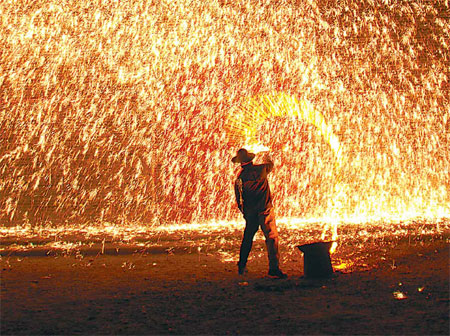
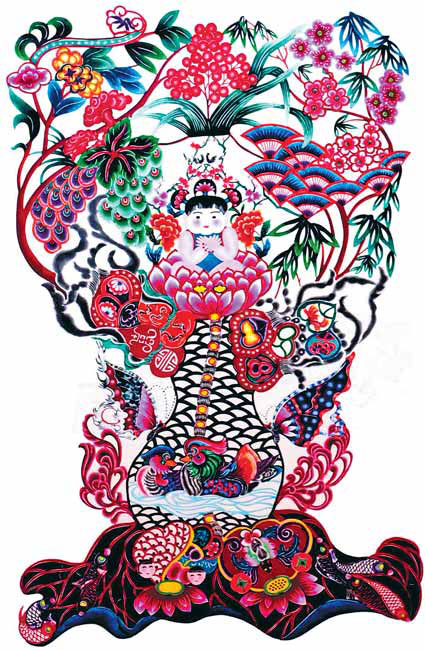
Top: Melted iron turns into a shower of sparks in a dashuhua performance in Yuxian. Above: Yuxian's paper-cuttings usually feature varied colors and vivid images. Photos Provided to China Daily |
It is no wonder UNESCO has recognized paper-cutting works in the county as an intangible cultural heritage, according to Liu Zhihua, in Zhangjiakou, Hebei province.
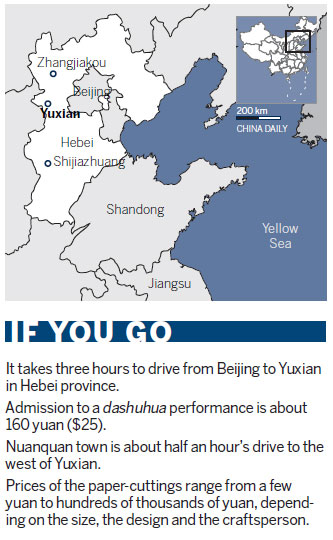
If you are tired of the city, a visit to Yuxian in Zhangjiakou city, Hebei province, is a refreshing change, especially for those interested in cultural heritage.
My first stop is Nuanquan town, which literally means "warm spring", and refers to a river that runs through it and never freezes, even in winter.
Located in the western part of Yuxian, Nuanquan is thought to have been inhabited up to 20,000 years ago.
It is the only Historical and Cultural Town in Hebei province, designated by the State Administration of Cultural Heritage. Most of its well-preserved courtyards were built during the Ming Dynasty (1368-1644).
As I walk under the high walls of the well preserved Xigubu, or West Ancient Fort, I understand why the town has become such a popular filmmaking location.
In its 210 courtyards, there are time-honored buildings, antique furniture, farm tools, but few tourists.
I also come across dashuhua, or traditional spraying iron craftsmanship.
Legend has it that in ancient times, blacksmiths in Nuanquan used to throw hot melted iron against the cold walls during Lantern Festival. When the metal struck the walls, it exploded into a shower of sparks to scare demons away.
The tradition has remained for more than 300 years but now has become a kind of performance for tourists.
When folk dance performances end during the evenings in Shuhua Square, dashuhua takes place.
Performers wear sheepskin coats and a hat, and quickly throw the melted metal with a soaked wooden ladle.
Traditional paper-cutting is another craft that thrives in the town. Locals claim Yuxian is home to the country's best paper-cutting works.
Paper-cutting shops are everywhere I go and are a feast for the eyes, in the largest paper-cutting market in the west part of downtown.
The market is newly established on a street that takes less than 10 minutes to walk around. But the paper-cuttings in the two-story stores are so engaging, it's easy to spend a whole afternoon browsing.
Yuxian's paper-cutting works are unique. Most of them are not symmetrical, and many have a variety of colors. They look more like paintings or photos.
"We sculpt and paint on the paper," says Jiao Xinsheng, a storekeeper in his 40s.
"It is a century-old art in the county. I learned the skill at a very young age. It is a family tradition."
Jiao's shop is piled high with paper-cutting works. On two tables near the door, small paper-cutting works are stacked one on top of another. Most of them are red or blue, with simple images of animals and flowers.
On the shelves, on the walls, and even on the ground, there are carefully displayed paper-cutting works of various colors, sizes and patterns.
The smallest are no bigger than my palm, but the large, framed ones are up to 1.5 meters high and 2 meters wide.
There are images of Confucius, Buddha, legendary heroes, Peking Opera masks, Chinese characters and traditional patterns of birds, flowers and insects. Some paper-cutting works resemble oil paintings and photos of the founders of the People's Republic of China.
Their vividness is the result of a special technique called yin cutting, using small knives to nick small patterns, leaving more of the paper to paint on, Jiao tells me.
To help me better understand the process, Jiao invites me to the second floor.
A dozen young people, mostly women, are bending over and working on the paper-cuttings.
The first step is to create a draft pattern, either through painting or printing.
When the draft pattern is ready, it is sewn together with five to 20 layers of paper, which are then made into a piece of cardboard, through being soaked in water and dried in the air.
Artisans then carve out the designs and separate the layers, and paint on about five layers each time. In the end, the painted layers are assembled into impressive paper-cuttings.
It is said that Yuxian paper-cutting dates back to the Ming Dynasty.
In 2009, UNESCO put it on the Representative List of the Intangible Cultural Heritage of Humanity.
On the outskirts of Yuxian, villages have made a name for themselves, and a fortune, from paper-cutting; while many of the craftspeople have become famous and sold their works abroad.
I couldn't resist buying a lot of paper-cuttings, of course, since they are so beautiful and relatively inexpensive.
Contact the writer at liuzhihua@chinadaily.com.cn.


Copyright 1995 - 2010 . All rights reserved. The content (including but not limited to text, photo, multimedia information, etc) published in this site belongs to China Daily Information Co (CDIC). Without written authorization from CDIC, such content shall not be republished or used in any form. Note: Browsers with 1024*768 or higher resolution are suggested for this site.
License for publishing multimedia online 0108263 Registration Number: 20100000002731