A hard day's night
 |
|
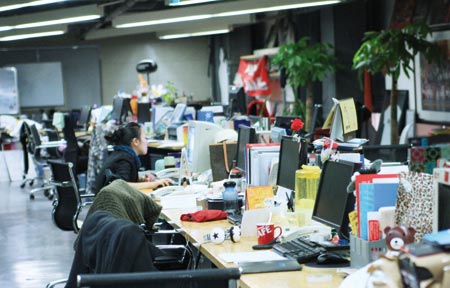
An office worker from a media company in Beijing works overtime. Tian Quan'er / for China Daily |
After working non-stop for 36 hours at her office, Wang Jijiang, a media planner from Shanghai, feels dizzy and drained.
"My brain doesn't seem to be working. I don't have time to take a nap. Actually, I don't even have the energy to think if I'm tired or not," says the 25-year-old, who earns 5,000 yuan ($788) a month.
Wang is one of the many office workers in China who claim they have to work excessively due to fierce competition and pressure.
More than 30 percent of those who participated in a survey in April claimed they have worked more than 10 hours every day since January, with the longest being about 16 hours a day. The survey, jointly conducted by Zhaopin.com, an employment guide website, and Peking University's Social Research Center, also discovered that about two thirds of those surveyed continued to work at home after leaving their office.
Wang says she has to work overtime between nine and 10 months in a year, and finishes work at 8 pm or 9 pm on average. During year-end, which is the company's peak period, she sometimes works until 2 or 3 am. There are also occasions when she stays up all night. She says working long hours is very common in the media agency industry.
"My home is more like a hotel to me. I leave the house in the morning and only go back to sleep," says Wang, who joined her company at the end of 2010.
She is not entitled to overtime pay, but her meals are subsidized - 30 yuan if she works after 8 pm and 60 yuan if she works till midnight.
"Sometimes I'll be so busy that I've no time to go to the restroom or drink water. Working overtime also makes me lose my temper easily," she says.
According to Wang, there are various reasons for working overtime, including too much work, low work efficiency and arriving late for work. Wang says her main reason is she has too much to do.
She says she was busier in 2011, and only got a monthly salary of 3,500 yuan. But money is not her priority. What's important is she loves her job.
For Zhu Lina, who works at a Shenzhen IT company, in Guangdong province, working overtime has "left her with no personal life".
"I'm unhappy because I don't have time for myself. I've become dull and I don't have time to relax," Zhu says.
According to Zhen Zhiqiang, 35, who works for a foreign company in Beijing, when he first joined the workforce in 1999, he didn't have to work late often.
But as his company's business grew, he had more work to do.
In recent years, the situation is the same in some State-owned enterprises.
"Working overtime is very common now, as our workload has increased. I'm used to it," says Zhang Qiang, who works in a State-owned enterprise in Shandong province.
In the 1980s, Japan was abuzz with the term karoshi, which means "worked to death", as media reported many cases of sudden deaths involving middle-aged senior administrators.
A similar phenomenon has emerged in China in recent years. For example, in May, Jiangsu TV reported a 30-year-old man from an IT company died of myocardial infarction after working overtime for a month.
Many white-collar workers have also developed aches around their necks, shoulders and lumbar vertebra, because they sit all day in front of their computers.
"My skin has deteriorated. Lack of sleep makes me depressed. And whenever I've time, I just want to sleep or be alone," Zhu says.
"But I'm beginning to change my lifestyle. For instance, I go hiking often now," Zhu adds.
According to Yu Guofu, a partner with Beijing Shengfeng Law firm, the Chinese labor law requires employers to pay for overtime work. He says the law also stipulates that one cannot work more than three hours of extra time a day and total overtime should not exceed 36 hours every month, except during special urgent situations.
"The rules are clearly stated in the law, but there are circumstances when it is not followed. For example, it's difficult to find a job, so, many will not quarrel with their bosses over this issue. We've not received many cases of workers asking for redress over overtime work."
xulin@chinadaily.com.cn