
 Comments()
  Print
Print  Mail
Mail  Large Medium Small
Related: From rocks to flocks
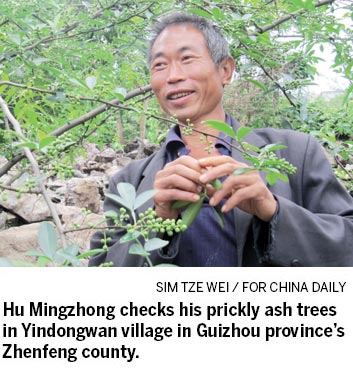
Hu Mingzhong sometimes visits his former residence on the other side of Yindongwan village. The 48-year-old's previous 90-square-meter tile-roofed flat has three rooms, which sheltered the family of five in the 1980s.
Back then, the family in Qianxinan autonomous prefecture's Zhenfeng county had few household appliances.
There was no electricity in the village.
"I only had two sets of clothes," Hu recalls.
The family eked out a living growing corn, a major source of villagers' incomes and food, in addition to government relief and grain borrowed from relatives.
Yindongwan is nestled in a river valley on Beipan River's southern bank. It has a population of 1,497.
Hu recalls the mountains surrounding his home were capped with dense trees in the 1960s and '70s. Because the hilly village lacked farmland, people burned plants and trees to clear space for farmlands.
"If we didn't reclaim the land, we couldn't have survived," he says. "But heavy rains washed away the soil after two or three years of farming. The mountains' base rocks were exposed."
Official figures show that, before 1990, a Yindongwan villager ate fewer than 100 kg of grain and earned a net income of 200 yuan ($31) a year. More than 95 percent of the mountains had eroded to rock, exacerbating natural disasters and poverty.
Realizing the land couldn't produce anything, Hu's family left Yindongwan in 1986. They resettled in the neighboring Majiaping Farm, where Hu and his wife landed jobs as orchard guardians.
Hu met Yindongwan village's Party secretary Luo Zeliang years later at a bazaar. Luo told him planting prickly ash had become villagers' new hope for better lives.
Yindongwan receives 800 mm of annual precipitation and suffers winter and spring droughts, the village's chief Lou Dechang says.
In 1992, a villager discovered prickly ash could grow on thin soil with little water and generate higher productivity than corn. The practice was later promoted throughout the village, he says.
The Hu family moved back to Yindongwan and started to plant prickly ash in 1998. Hu bought 50 kg of seeds for 100 yuan and sowed them over about 2 hectares.
Prickly ash seeds germinate in 20-35 days, and Hu waters the plants once a week.
"The only problem is that I must get water from a pond that's more than 1 km away," Hu says. "The prefecture's government sent technicians to bring in agricultural knowledge. I also found the skills I had learned at the orchard were helpful."
He started making profits in 2001, when he earned 20,000 yuan. Hu and his wife had earned a maximum of 120 yuan a month when tending the orchard.
The family's contracted land now hosts more than 6,000 prickly ash trees, which generate more than 50,000 yuan a year.
Hu can also afford to hire workers to help with harvests for about 10,000 yuan a year.
Dingtan district, which includes Yindongwan and two other villages, now boasts 3,866 hectares of prickly ash. About 92 percent of its eroded land has been replenished. Villagers earn a net of about 5,000 yuan per capita a year.
Farmers sell seeds to provinces that consume prickly ash and to processing factories in nearby Beipanjiang township.
The eight members of Hu's family now dwell in a three-story, 300-square-meter house, which has become typical of the village's dwellings.
Hu also raises pigs and cows. He bought a minivan in January and provides travel services between the township and Yindongwan.



Copyright 1995 - 2010 . All rights reserved. The content (including but not limited to text, photo, multimedia information, etc) published in this site belongs to China Daily Information Co (CDIC). Without written authorization from CDIC, such content shall not be republished or used in any form. Note: Browsers with 1024*768 or higher resolution are suggested for this site.
License for publishing multimedia online 0108263 Registration Number: 20100000002731